Fuji GW690III
Introduced: 1992 Discontinued: 2004
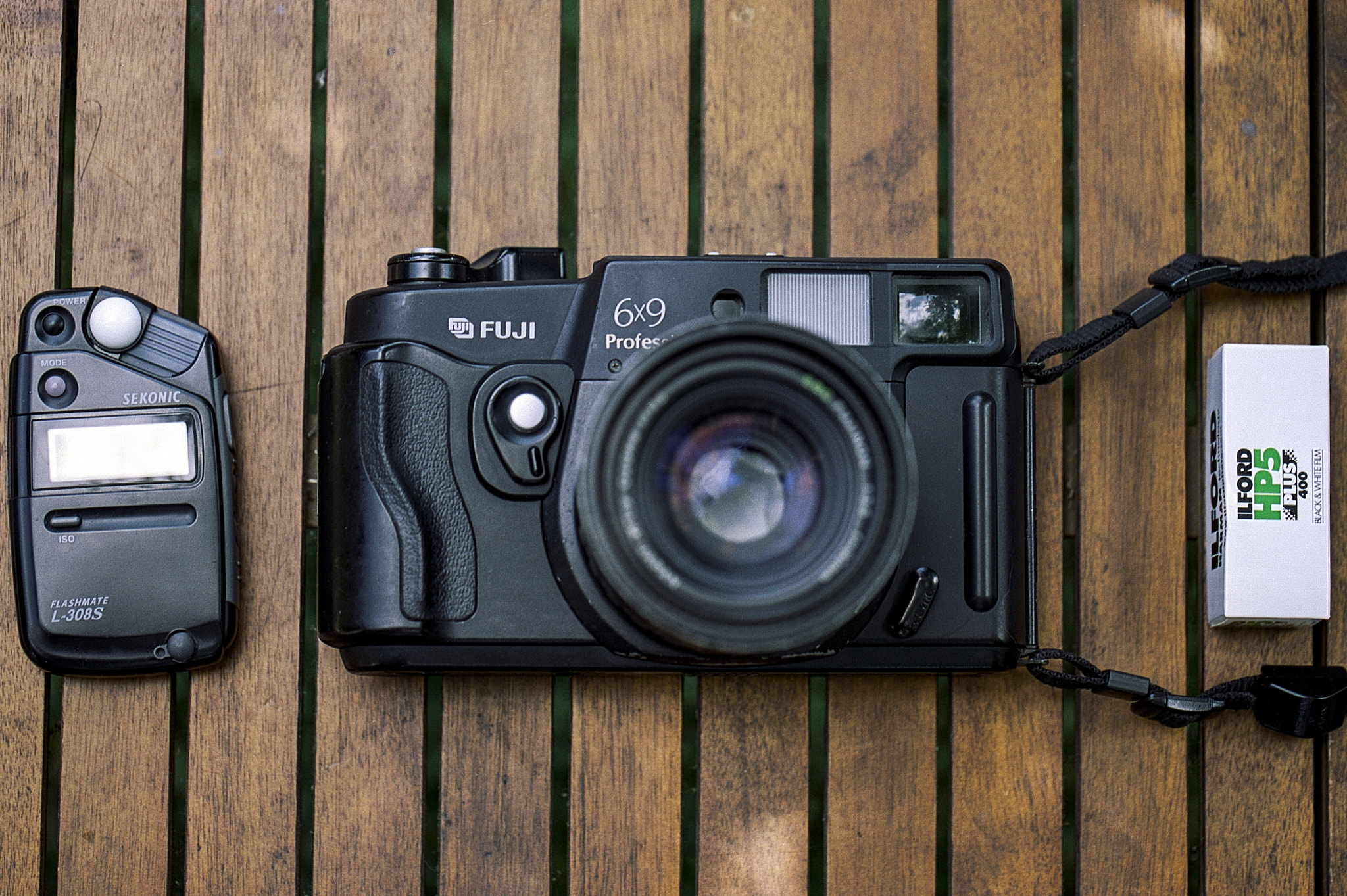
Fuji GW690III is the 6×9 medium-format rangefinder — in production 1992-2004. Affectionately nicknamed the "Texas Leica" for its huge size, the GW690III shoots only 8 frames per roll of 120 — but each frame captures a 6×9 cm negative roughly 5x the area of a 35mm frame. Fixed-lens design with a Fujinon EBC 90mm f/3.5 lens (equivalent to ~40mm on 35mm).
Key features
- 6×9 cm format on 120 (8 exp) or 220 (16 exp) — the largest standard medium-format frame
- Fixed Fujinon EBC 90mm f/3.5 lens — multi-coated; sharp at f/8-f/11; 67mm filter thread
- Mechanical leaf shutter — 1s to 1/500, X-sync at all speeds; battery-independent
- Manual exposure only — no AE, no built-in meter (use accessory or experience)
- Coupled rangefinder — bright frameline finder with parallax correction
- Crank-wind film advance
Practical notes
- GW690III bodies on used market: $700-1500 working examples
- Heavy and bulky — 1.5 kg with film loaded; substantially larger than 6×4.5 or 6×6 cameras
- Common service items: shutter calibration (electronic-mechanical hybrid develops timing drift after decades), light-trap foam
- The 6×9 format produces remarkable detail — drum-scanned 6×9 negatives compete with 4×5 in resolution at typical print sizes
- The GW690III is the "III" of three generations: GW690 (1978), GW690II (1985), GW690III (1992); each generation refined ergonomics and added small features
Cultural significance
The "Texas Leica" nickname captures the camera's character: rangefinder operation (Leica-like) at oversized scale (Texas-like). Among the most-photographed-with cameras for serious medium-format landscape work since the 1980s. Particularly favored by panoramic landscape photographers (the 6×9 ratio is closer to traditional cinema than the 6×6 square).
Related cameras
- Fuji GA645 — sibling 6×4.5 autofocus MF rangefinder
- Hasselblad 503CW — 6×6 SLR MF alternative
- Pentax 67II — interchangeable-lens 6×7 SLR MF alternative