Bronica GS-1
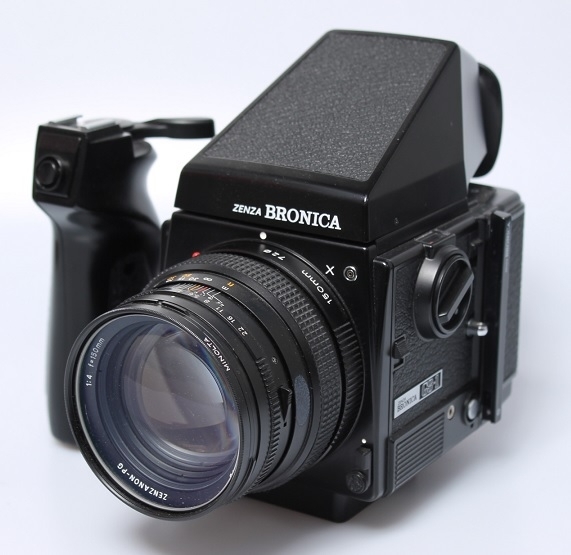
Overview
The Bronica GS-1 is Bronica's 6×7 medium-format SLR — the largest-format SLR Bronica ever made and a direct competitor to the Mamiya RB67 / RZ67 and the Pentax 67 family. Introduced in March 1983, the GS-1 was the first medium-format camera with TTL flash metering at launch, a notable design achievement in the era when most MF systems were still using auto-thyristor flashes or manual flash exposure calculation.[1] Production ran for 19 years until June 2002, when Tamron — Bronica's owner since the 1998 merger — ended GS-1 manufacturing as part of the company's broader medium-format SLR wind-down.[2]
For 6×7 photographers buying into medium-format film today, the GS-1 occupies a distinctive niche: lighter than the Mamiya RB67 / RZ67 (630 g body vs. RB67's ~1,200 g body), modular like the RB67/RZ67 and Pentax 67 (interchangeable backs and finders), but with TTL flash from launch (the RB67 doesn't have it; the RZ67 added it later). The GS-1 also has the unusual capability of multi-format backs — 6×4.5, 6×6, and 6×7 backs all fit the GS-1 body, letting a photographer choose format roll-by-roll. No other 6×7 SLR system offers this flexibility natively.
The trade-off: a smaller lens lineup (9 focal lengths) than the Pentax 67 (~20 lenses) or Mamiya RB67/RZ67 (~10–12). Specialist focal lengths (fisheye, super-tele) that exist in the Pentax 67 lineup don't have GS-1 equivalents.
Construction and build
- Body weight — 630 g body only (~1.8 kg fully loaded with lens + back + waist-level finder).[1] The lightest 6×7 SLR body of its era — meaningfully lighter than the Mamiya RB67 (~1,200 g), the Mamiya RZ67 (~1,300 g), or the Pentax 67 (~1,200 g body alone).
- Auxiliary focal-plane shutter in the body (mirror-up function only; does not time the exposure).
- Electronic Seiko #0 leaf shutter in lens — speeds 8 s through 1/500 s plus B.[1]
- X-flash sync at all shutter speeds — leaf-shutter advantage. Combined with TTL flash metering (below), this gives the GS-1 the most capable flash workflow of any 6×7 SLR.
- Materials — engineering-plastic body shell over a die-cast aluminum chassis; metal lens mount, back interface, and finder interface; rubber-textured grip surfaces. Same aesthetic as the Bronica SQ-A and ETRSi bodies — workmanlike rather than premium.
The body is fully battery-dependent — a dead battery prevents shutter operation entirely. Battery: 6V silver-oxide / lithium (PX28 / 4LR44).
Distinguishing features
TTL flash metering — first for medium format
The GS-1 was the first medium-format camera with TTL flash capability at its 1983 introduction.[1] The flash sensor reads off a white reflective patch in the body during the actual exposure cycle and signals compatible Bronica flash units to cut off when the integrated flash energy is sufficient. This is the same off-the-film TTL flash approach used by Olympus OM-2 (35mm, 1975), but applied to 6×7 medium format five years before competing systems caught up.
For wedding and portrait photographers shooting 6×7 with mixed ambient + flash exposure, the GS-1's TTL flash automation is a meaningful workflow advantage over the Pentax 67 (no TTL flash) or the Mamiya RB67 Pro-S (no TTL flash). The Mamiya RZ67 Pro II (1995) and Pentax 67II (1998) eventually added TTL flash, but by then the GS-1 had been the TTL-flash-equipped 6×7 leader for a decade-plus.
Multi-format backs
The GS-1 accepts interchangeable film backs in 6×4.5, 6×6, 6×7, and Polaroid formats — an unusually flexible architecture for a 6×7 body.[1] The 6×7 back gives 10 frames per 120 roll; the 6×6 back gives 12 frames; the 6×4.5 back gives 15 frames. Same image circle (the lens is designed for 6×7 coverage), with the back masking off the unused area.
This lets a photographer carry one body and three backs to shoot any of the three formats without changing cameras. No other 6×7 SLR offers this — the Mamiya RB67 / RZ67 are 6×7-only; the Pentax 67 is 6×7-only.
Rotary AE Prism Finder G
The GS-1's optional Rotary AE Prism Finder G is a notable accessory: an AE prism finder that rotates 90° to provide horizontal vs. vertical viewing without tilting the entire camera. For photographers shooting handheld in landscape orientation but wanting eye-level viewing comfort across both portrait and landscape orientations, the rotary finder transforms ergonomics. The Standard AE Prism Finder G (non-rotating) is the more affordable option.
Modular system
Interchangeable film backs
- 6×7 back — 10 frames at 6×7 cm (the standard / largest-format option).
- 6×6 back — 12 frames at 6×6 cm.
- 6×4.5 back — 15 frames at 6×4.5 cm.
- Polaroid back — instant-film proofing.
- All available in 120 or 220 versions (220 doubles the frame count).
Interchangeable finders
- Waist-Level Finder — folding hood, no metering, ground-glass viewing. Lightest option.
- Standard Pentaprism Finder G — eye-level prism, no metering.
- AE Prism Finder G — eye-level prism with center-weighted TTL meter and aperture-priority autoexposure.
- Rotary AE Prism Finder G — 90°-rotating eye-level AE prism for orientation comfort.
- Speed Grip — accessory grip for portrait-orientation handling.
Lenses
The Bronica GS ("PG") mount accepts 9 focal lengths plus teleconverters:[1]
- 50mm f/4.5 PG — wide-angle (covers 6×7)
- 65mm f/4 PG — moderate wide
- 80mm f/2.8 PG — moderate wide-normal
- 100mm f/3.5 PG — the standard "kit" normal
- 110mm f/4 PG Macro — macro normal
- 150mm f/4 PG — short telephoto / portrait
- 200mm f/4.5 PG — telephoto
- 250mm f/5.6 PG — long telephoto
- 500mm f/8 PG — long-tele / specialty
All PG-mount lenses have integrated Seiko #0 electronic leaf shutters. The PG mount has a flange-focal distance of approximately 85 mm (different from the Bronica SQ mount, despite both being called "B" bayonets in some literature) — PG lenses do not interchange with SQ or ETR bodies.
The smaller lens lineup vs. the Pentax 67's ~20 focal lengths is a real consideration for buyers — there's no fisheye, no 1000mm reflex tele, no shift lens. For photographers who need those specialties, the Pentax 67 system is the better choice. For photographers covering mainstream 50–250 mm focal lengths, the GS-1 lineup is sufficient.
Working notes
- Battery dependency is total. Both the body's electronics and the lens's leaf shutter need power.
- Mirror lockup is present (essential for tripod work below 1/30 s).
- Multi-format-back flexibility is unusual — keep a 6×4.5 back in the kit even if you primarily shoot 6×7; it lets you quickly switch when a subject suits a different aspect ratio.
- Rotary AE prism finder is a luxury for handheld work — strongly recommended for wedding / event photographers but excessive for landscape work where tripod orientation handles framing.
- Self-timer — electronic, ~10-second delay.
- The GS-1 weighs noticeably less than the Mamiya RB67 / RZ67 — handheld shooting is more sustainable for extended sessions; tripod work doesn't show the weight advantage.
- TTL flash works only with compatible Bronica flash units — third-party flashes work in manual mode but can't access TTL automation. Compatible: Bronica 24G, Sunpak / Norman / Vivitar with appropriate Bronica modules.
- Common service items on a 25+-year-old body: foam light seals, leaf-shutter timing per lens, AE Prism Finder battery contacts, mirror dampers, back-to-body interlock springs. Bronica specialist CLA: $250–400 for body; $150–250 per lens.
Used market and reliability
- GS-1 body only (no finder, no back) — working condition: $400–700 (US 2026 pricing).
- GS-1 body + 6×7 back + Waist-Level Finder + 100mm f/3.5 PG — working condition: $700–1,000. Common landscape kit.
- GS-1 body + 6×7 back + AE Prism Finder G + 100mm f/3.5 PG — working condition: $900–1,300. Most-recommended kit configuration.
- GS-1 body + multiple backs (6×7 + 6×4.5) + 100mm + 150mm + Rotary AE Prism Finder G + Speed Grip — working condition: $1,800–2,800. Wedding-photographer-style modular kit.
The GS-1 trades for less than the Pentax 67 and meaningfully less than the Mamiya RB67 / RZ67 because the GS-1's smaller production volume (~22,500 bodies) means a smaller used-market accessory pool. For photographers who can find the kit components they want, the GS-1 is the price/feature winner in the 6×7 SLR class; for those needing extensive lens lineups or accessory variety, the Pentax 67 or Mamiya systems may be more practical.
Common buying-checklist items: leaf shutter timing per lens (each speed), body's mirror release function, light seals on the back and body, AE Prism Finder battery operation, multi-format-back compatibility (test that each back you own locks correctly to the body), TTL flash circuit (test with a compatible Bronica flash unit).
Tamron-era context
The GS-1's production end was driven by Tamron's 1998 acquisition of Bronica and subsequent decision to wind down medium-format SLR production:[2]
- February 1995 — Tamron acquired 75% of Bronica's capital.
- July 1998 — Full merger; Bronica became part of Tamron.
- June 2002 — GS-1 production ends — the first of Bronica's SLR systems to be discontinued under Tamron.
- October 2005 — Bronica brand terminated entirely with the RF645 rangefinder discontinuation.
The GS-1's earlier discontinuation than the ETRSi (2004) and SQ-Ai (2003) reflects the smaller production volume and lower replacement-parts demand for the niche 6×7 system.
Related cameras
- Mamiya RB67 Pro-S — the canonical 6×7 modular SLR; rotating-back bellows-focus design; heavier, larger lens lineup
- Mamiya RZ67 Pro II — the electronic-shutter RB67 successor; added TTL flash; closer feature parity with GS-1
- Pentax 67 — the "super SLR" 6×7; non-modular (fixed back); broadest 6×7 lens lineup
- Pentax 67II — the 1998–2009 67 successor with AE prism + electronic mirror damping
- Bronica ETRSi — Bronica's 6×4.5 sibling; smaller format; shares modular philosophy
- Bronica SQ-A — Bronica's 6×6 sibling; square format; shares modular philosophy
External references
- Bronica GS-1 (Camera-Wiki) — community-edited reference for body specifications, lens lineup, and production history
- Bronica (Wikipedia) — company history and Tamron-era discontinuation timeline
References
- WEB Bronica GS-1 Camera-Wiki. https://camera-wiki.org/wiki/Bronica_GS-1 ↩
- WEB Bronica Wikipedia. https://en.wikipedia.org/wiki/Bronica ↩