Bronica SQ-A
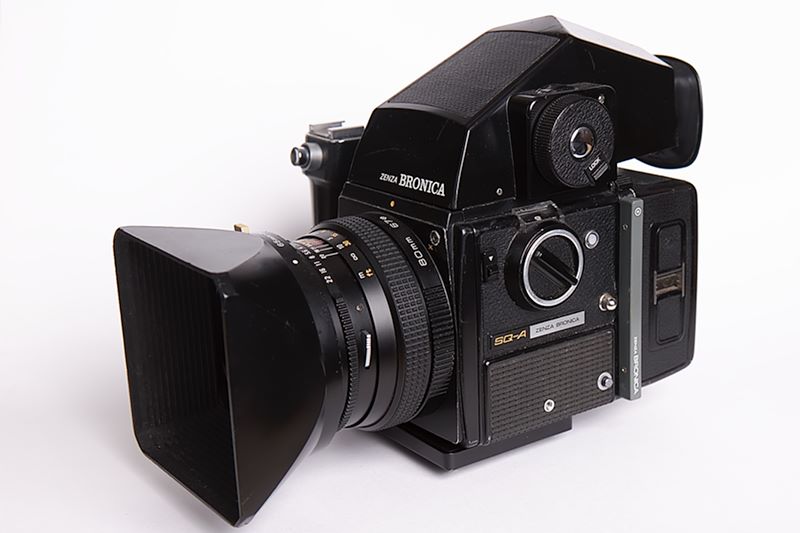
Overview
The Bronica SQ-A is the second-generation 6×6 SLR in Zenza Bronica's SQ ("Square") series — a 1982 successor to the original SQ (1980) that adds mirror lockup and a redesigned AE prism finder system with center-weighted TTL aperture-priority metering. The SQ-A established the SQ system's professional credentials and remained in production through the mid-1990s before being supplanted by the SQ-Ai (1990, added TTL flash) and the SQ-B (1996, budget configuration).[1][2]
For photographers buying into 6×6 medium-format film today, the SQ-A is positioned as a Hasselblad alternative at 30–50% of the price — the same square negative format and modular system architecture (interchangeable backs, finders, focusing screens), built around an in-lens leaf shutter that delivers flash sync at all shutter speeds, but with engineering-plastic body construction rather than Hasselblad's all-metal jewelry-box feel. The result is a working 6×6 system at meaningfully lower entry cost than the Hasselblad 500CM, with kit pricing (body + 120 back + AE Prism + 80mm normal lens) typically $700–1,200 vs. $2,500–4,500 for an equivalent Hasselblad configuration.
The SQ-A predates the SQ-Ai's 1990 TTL flash addition, so flash-intensive photographers may prefer the later SQ-Ai. Photographers who don't use flash or who use manual flash with hand-calculated exposures find the SQ-A's pricing-and-feature balance attractive.
Construction and build
- Body dimensions — 80 × 105 × 95 mm (W × H × D, with the standard 80mm Zenzanon-S lens mounted; body-only depth is ~50mm without the lens).
- Body weight — approximately 700 g body only (~1.6 kg fully loaded with 120 back + waist-level finder + 80mm lens, per ballpark figures across multiple kit-weight references).
- Auxiliary focal-plane shutter in the body (mirror-up function only; does not time the exposure).
- Electronic Seiko leaf shutter in lens — speeds 8 s through 1/500 s plus T.[1] T mode is held-open until the shutter is fired again; the original SQ used T mode; later SQ-B and SQ-Ai bodies switched to B (bulb) mode.
- X-flash sync at all shutter speeds — the great advantage of leaf-shutter design.
- Materials — engineering-plastic body shell over a die-cast aluminum chassis; metal lens mount, back interface, finder interface, and focusing-screen frame. The SQ-A's build is workmanlike rather than premium — closer to the Mamiya 645 Pro TL's plastic-and-metal construction than to the Hasselblad 500CM's all-metal feel.
The body is fully battery-dependent — a dead battery prevents shutter operation entirely (the in-lens shutter needs power). Battery: 6V silver-oxide / lithium (PX28 / 4LR44).
Distinguishing features (vs. original SQ)
The "A" in SQ-A marks two key additions over the 1980 original:[1]
- Mirror lockup — the SQ-A added a mirror-up switch for tripod work below ~1/30 s where mirror vibration can soften images. The original SQ lacked this, and Bronica's user feedback drove the addition.
- AE Prism Finder S — a new electronics-equipped prism finder providing center-weighted TTL ambient metering and aperture-priority autoexposure. The original SQ's prism finder lacked metering. The new AE Prism is incompatible with the original SQ body due to additional electronic connector pins introduced for the metering circuit — this is the reason the SQ-A model designation exists rather than an "SQ + new prism" rollout.
Other refinements:
- Grey-color locking dark slide — the back's dark slide locks into the back when removed (preventing accidental loss in transport); the grey color is the visual marker for SQ-A-era backs vs. the original SQ's black-handle dark slides.
- Improved film advance reliability — minor mechanism revisions over the original SQ.
The SQ-A does not include TTL flash metering — that feature was added in the SQ-Ai (1990) along with bulb mode. Photographers who shoot flash on the SQ-A use either manual flash exposure (calculate with guide-number arithmetic) or auto-thyristor flash (sensor on the flash, not the camera). The leaf-shutter all-speed sync still applies: the SQ-A can fire flash at 1/500 s; it just can't meter the flash through the lens.
Modular system
The SQ-A accepts the full Bronica SQ system of interchangeable accessories.
Interchangeable film backs
- 120 roll film back — 12 frames at 6×6.
- 220 roll film back — 24 frames at 6×6.
- 6×4.5 mask insert — converts a 6×6 back to capture 16 frames at 6×4.5 (rather than a separate dedicated 6×4.5 back).
- Polaroid back — instant-film proofing.
Backs lock to the body via dark-slide-required interlock (same workflow as the Bronica ETRSi but with the larger 6×6 frame). Pull slide → unlock back → swap → reinsert slide → fire shutter.
Interchangeable finders
- Waist-Level Finder — folding hood, no metering, ground-glass viewing. The classic 6×6 viewing experience. Lightest option.
- Standard Pentaprism Finder — eye-level prism, no metering.
- AE Prism Finder S — eye-level prism with center-weighted TTL meter and aperture-priority autoexposure. Exposure compensation ±2 EV.
- Chimney Finder — elevated viewing for waist-level-style use with eyepiece magnification.
- Speed Grip — accessory grip for portrait-orientation handling (does not include metering).
Lenses
The Bronica SQ ("PS") mount accepts roughly 12 focal lengths in the Zenzanon-S / Zenzanon-PS lens lineup:
- 40mm f/4 wide-angle (PS — fisheye-adjacent ultra-wide)
- 50mm f/3.5 (PS — wide-angle)
- 65mm f/4 PS Macro
- 80mm f/2.8 (PS — the standard "kit" normal)
- 110mm f/4 PS Macro
- 150mm f/3.5 (PS — short telephoto / portrait)
- 180mm f/4.5 (PS — alternative tele)
- 200mm f/4.5 (PS — telephoto)
- 250mm f/5.6 (PS — long telephoto)
- 500mm f/8 (PS — long-tele)
- 75–150mm f/4.5 zoom (PS)
- Various PS / S generation refinements
All SQ-mount lenses have integrated Seiko electronic leaf shutters. The PS = "Plus S" line is Bronica's later multicoated version; the original S line is also widely available used.
Working notes
- Battery dependency is total — the body's electronics and the lens's leaf shutter both need power.
- Mirror lockup essential for tripod work below 1/30 s. Same considerations as any 6×6 SLR.
- Lens removal requires pressing the lens-release button on the body and rotating the lens counterclockwise.
- The 6×6 viewing experience differs from 6×4.5. The square ground-glass image makes composition decisions more deliberate — there's no horizontal/vertical orientation choice to make. Many photographers find this liberating; others find it constraining.
- No TTL flash on the SQ-A. Use manual flash + guide-number math, or auto-thyristor flash, or upgrade to the SQ-Ai for built-in TTL flash.
- Self-timer — electronic, ~10-second delay.
- Common service items on a 30+-year-old body: foam light seals, leaf-shutter timing per lens, AE Prism Finder battery contacts, mirror dampers. Bronica specialist CLA: $200–350 for body; $150–250 per lens.
Used market and reliability
- SQ-A body only (no finder, no back) — working condition: $300–500 (US 2026 pricing).
- SQ-A body + 120 back + Waist-Level Finder + 80mm f/2.8 PS — working condition: $700–950. Common kit for landscape / casual work.
- SQ-A body + 120 back + AE Prism Finder S + 80mm f/2.8 PS — working condition: $850–1,200. The most-recommended kit configuration.
- SQ-A body + 120 back + AE Prism Finder S + 80mm + 150mm f/3.5 PS — working condition: $1,100–1,500. Portrait-extension kit.
The SQ-A trades for less than the SQ-Ai (which trades $400–600 body / $1,000–1,500 kit). Photographers who need TTL flash should pay the premium for the SQ-Ai; those who don't can save 25–40% buying the SQ-A.
Common buying-checklist items: leaf shutter timing per lens, body shutter (mirror release) consistency, light seals on the back and body, AE Prism Finder battery operation, mirror dampers, dark-slide lock function.
SQ family lineage
The Bronica SQ series:[1]
- SQ (1980–1982) — the original; no MLU; non-AE-capable prism finder.
- SQ-A (1982–1995) — this page; adds MLU + AE Prism Finder S support.
- SQ-Am (1985) — SQ-A with built-in motor drive (the "m" suffix). Otherwise the same as SQ-A.
- SQ-Ai (1990–2003) — adds TTL flash metering and B mode (replaces T); the most refined SQ. Production ended September 2003.
- SQ-B (1996–2003) — budget version of SQ-Ai; lacks AE finder support and some interlocks. Targeted at photographers wanting the SQ system at lower entry cost.
Tamron-era context
The SQ family's production end was driven by Tamron's 1998 acquisition of Bronica and subsequent decision to wind down medium-format SLR production:[2]
- February 1995 — Tamron acquired 75% of Bronica's capital.
- July 1998 — Full merger; Bronica became part of Tamron.
- September 2003 — SQ-Ai production ends.
- 2003–2004 — SQ-B production winds down.
The decision to discontinue was driven by digital-SLR market displacement and the absence of a Bronica digital back equivalent for the SQ system (Hasselblad's V-system received digital backs from various third parties; Bronica's SQ system did not see significant third-party digital back development).
Related cameras
- Hasselblad 500CM — the canonical 6×6 SLR; all-metal premium construction at 2–3× the SQ-A's price; broadly equivalent feature set
- Bronica ETRSi — Bronica's 6×4.5 sibling; smaller format; shares modular philosophy
- Bronica GS-1 — Bronica's 6×7 sibling; larger format; shares modular philosophy
External references
- Bronica SQ (Camera-Wiki) — community-edited reference covering the entire SQ series including SQ-A
- Bronica (Wikipedia) — company history and Tamron-era discontinuation timeline
References
- WEB Bronica SQ Camera-Wiki. https://camera-wiki.org/wiki/Bronica_SQ ↩
- WEB Bronica Wikipedia. https://en.wikipedia.org/wiki/Bronica ↩