Contax Aria
Overview
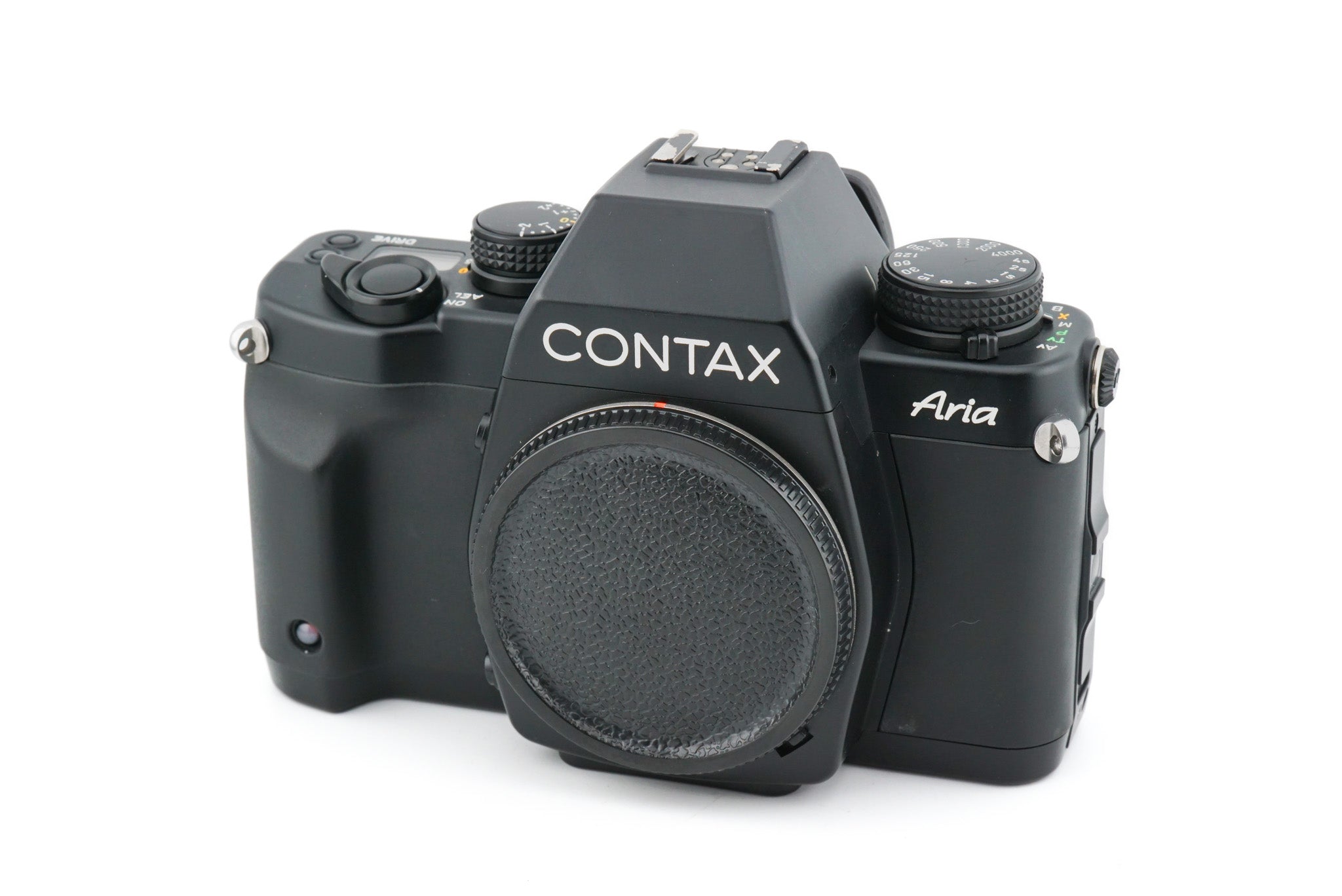
The Contax Aria is the final manual-focus C/Y mount Contax SLR — a 1998 compact body that paired the Carl Zeiss T* lens system with a meaningfully smaller, lighter chassis than the flagship RTS III or even the original Contax RTS.[1][2] Released in May 1998 and produced through 2005 (when Kyocera ended all Contax production), the Aria represents Kyocera's "lightweight Contax for travel and casual use" answer to the bulk of the RTS III — and is the lightest C/Y SLR body ever made at 460 g without batteries.[1]
For 35mm SLR photographers wanting a portable Carl Zeiss T* kit today, the Aria is the natural choice: an Aria + 50mm f/1.4 Planar T* runs roughly 700 g total vs. 1,400 g+ for an RTS III + 50mm f/1.4 kit. The 700-gram weight saving is the difference between a camera-as-jewelry kit and a camera-as-burden kit on extended walking days. The trade-offs vs. the RTS III: no vacuum film flattening (RTV is RTS III-exclusive), 1/4000 top shutter (vs. RTS III's 1/8000), no integrated motor drive at burst speed (Aria's continuous mode is 3 fps vs. RTS III's 5 fps), 95–97% viewfinder coverage estimated (vs. RTS III's 100%).
The Aria is also the first Contax with matrix metering — adding evaluative (matrix) metering alongside center-weighted and spot metering. This brought Contax in line with contemporary Nikon F5 / Canon EOS-1n flagships' metering sophistication.
Construction and build
- Body weight — 460 g without batteries — the lightest C/Y SLR ever made.[1]
- Body dimensions — substantially smaller than the RTS III (which is 156 × 121 × 66 mm); compact form factor closer to the RTS II era.
- Body materials — magnesium alloy body shell with leatherette covering. The magnesium chassis is the principal source of the weight reduction vs. brass-bodied Contax flagships.
- Shutter — vertical-traveling focal-plane shutter; speeds 30 seconds to 1/4000 second plus B.[1] 1/4000 is fast enough for typical fast-lens daylight shooting; not as fast as the RTS III's 1/8000.
- X-flash sync — 1/125 s.
- Battery — 2× CR2 lithium cells (or equivalent). Common modern battery; widely available.
Distinguishing features
The Aria's defining elements:[1]
Five exposure modes
The widest exposure-mode set on any C/Y body:
- Program (P) — camera selects both shutter speed and aperture
- Aperture-priority AE — set aperture; camera selects shutter speed (30s to 1/4000)
- Shutter-priority AE — set shutter speed; camera selects aperture
- Metered Manual — set both; LED indicator shows exposure offset
- Flash mode — automatic flash exposure with compatible Contax TLA flash units
The original RTS had only A and M modes; the RTS II added some refinements but retained two modes; the RTS III added P and S; the Aria is the only C/Y body with the full five-mode complement.
Three metering modes — Aria adds matrix to the C/Y line
- Evaluative (Matrix) metering — first time on a Contax body. Pentaprism-area-divided multi-pattern algorithm measures scene contrast and exposure-corrects accordingly.
- Center-weighted metering — standard Contax-line metering pattern.
- Spot metering — narrow-area metering for high-contrast scenes.
The matrix metering brings the Aria up to date with contemporary Nikon Color Matrix Metering and Canon Evaluative Metering of the late 1990s; for working photographers used to matrix metering on other systems, the Aria removes a meaningful workflow gap that earlier C/Y bodies left.
Integrated motor-driven film transport
3 fps continuous mode — fast enough for typical photographic action; not as fast as the RTS III's 5 fps. Single-shot mode also available.
DX coding with ISO 25–5000
Wide ISO range; DX-coded film auto-sets ISO; manual override available.
Compact magnesium body
The Aria's principal design goal was portability without compromising on Carl Zeiss T lens compatibility*. The magnesium chassis + smaller form factor vs. the RTS III + meaningful weight reduction over RTS II all serve this goal.
The Contax/Yashica (C/Y) mount and Carl Zeiss T* lens system
Same C/Y bayonet mount as every Yashica/Kyocera-era Contax 35mm SLR. Full Carl Zeiss T* lens compatibility — Distagon wides, Planar normals, Sonnar teles, Tessars. The Aria's compact body makes the smallest and lightest Carl Zeiss T* kits possible:
- Aria + 50mm f/1.4 Planar T* — ~700 g total. Travel-friendly. Canonical lightweight kit.
- Aria + 28mm f/2.8 Distagon T + 50mm f/1.4 Planar T + 85mm f/2.8 Sonnar T*** — ~1,200 g total. Multi-lens travel kit.
For working photographers carrying a Contax kit on extended walking / travel days, the Aria's weight advantage is meaningful — the lighter body + smaller-volume lenses vs. the RTS III result in a kit that can be carried all day without fatigue.
Working notes
- Battery dependency — body operation requires CR2 batteries. Modern batteries are widely available and inexpensive.
- DX-coding lets the camera auto-set ISO — useful for working photographers who shoot multiple film stocks; manual ISO override is also available.
- Self-timer — electronic, ~10-second delay.
- Custom Functions programming — multiple user-configurable behaviors (some via the body, some via accessory remote/data back). This is the most-customizable C/Y body.
- 70 Years Edition — limited-edition Aria (1999) celebrating Contax's 70th anniversary; same body with commemorative engraving and special leatherette.
- Common service items on a 25+-year-old body: light seals (foam strips around the back), shutter timing accuracy, AE meter calibration across all modes, viewfinder cleanliness, battery contact corrosion. Contax specialist CLA: $250–450 typically (less than RTS III but more than RTS II due to electronic complexity).
Used market and reliability
- Aria body only — working condition: $400–800 (US 2026 pricing).
- Aria body + 50mm f/1.4 Planar T* — working condition: $700–1,200.
- Aria kit (body + 28mm + 50mm + 85mm Carl Zeiss T)* — working condition: $1,400–2,400.
- Aria 70 Years Edition — working condition: $1,000–1,800. Collector premium.
The Aria's used market is healthy — being the final manual-focus C/Y body and combining the C/Y system's mature lens lineup with portability has kept buyer demand consistent. Pricing has held relatively stable since the 2005 brand-end.
Common buying-checklist items: shutter timing accuracy, AE meter operation across all five modes, matrix-metering function (test in tricky lighting against center-weighted to confirm matrix is working), light seal condition, motor drive operation, battery contact corrosion.
Related cameras
- Contax RTS — the 1975 founding C/Y body
- Contax RTS II — the 1982 refined flagship
- Contax RTS III — the 1990 technological flagship
- Contax 139 Quartz — the 1979–1987 mid-range volume body
- See [[contax-rts-aria-cluster-deepened]] for the broader Contax SLR comparison
External references
- Contax Aria (Camera-Wiki) — community-edited reference for body specifications
- Contax (Wikipedia) — brand history including 2005 Kyocera discontinuation
References
- WEB Contax Aria Camera-Wiki. https://camera-wiki.org/wiki/Contax_Aria ↩
- WEB Contax Wikipedia. https://en.wikipedia.org/wiki/Contax ↩