Leica M4
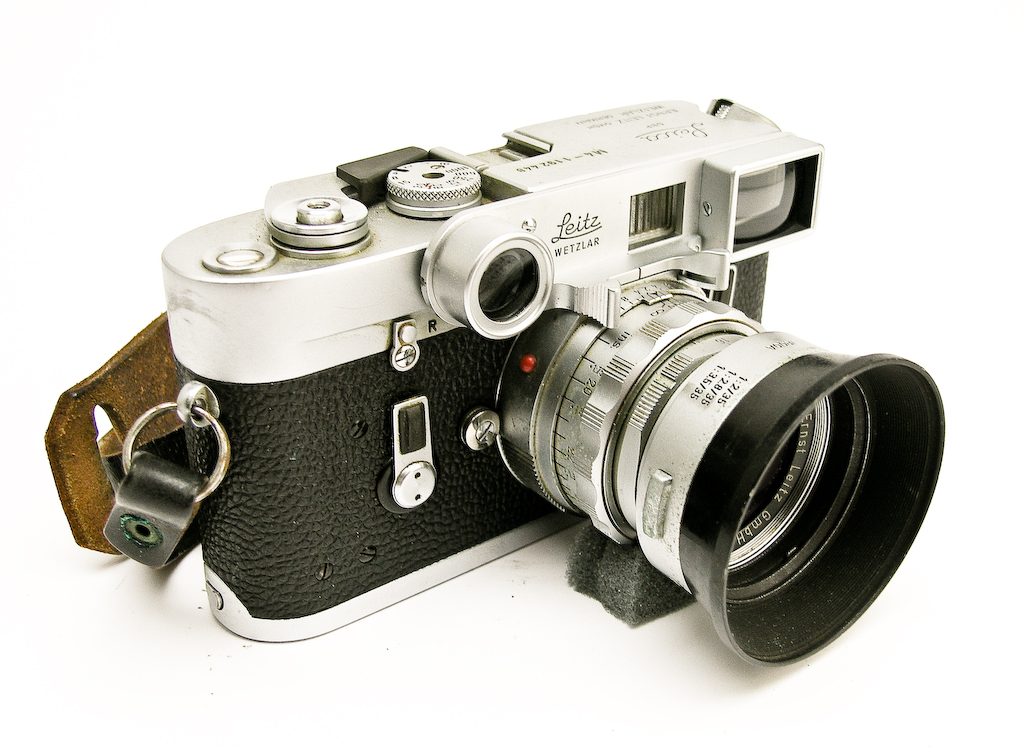
Overview
The Leica M4 is the working photographer's M — a refined evolution of the M3/M2 platform that addressed the M3's two most-cited daily-use frustrations (slow film loading, slow rewind) without changing the core mechanical design. Released in 1967, the M4 keeps the M3's cloth-curtain shutter, hand-built tolerances, and full mechanical operation; what's new is how quickly you can get film into and out of the body.[1] It also brings the 35mm frameline into the standard viewfinder for the first time on a full-system M body, making the M4 the first M genuinely usable as a 35mm-primary camera without accessories.
The M4 is widely described as "the photographer's Leica" — a reference both to its working-grade refinements and to its place in the lineage as the last M produced largely with hand assembly in Wetzlar before the manufacturing shifted to Canada (M4-2) and later Solms (M4-P). For photographers buying into the M system today who want the mechanical purity of an M3 with the practical-use refinements of later bodies, the M4 is often the sweet-spot recommendation.
Construction and build
- Body dimensions — 138 × 77 × 33.5 mm (same as M3/M2).
- Body weight — ~545–550 g.[1]
- Cloth horizontal-travel focal-plane shutter — speeds 1 s through 1/1000 s plus B. Fully mechanical timing — no electronics, no battery dependency.
- X-flash sync at 1/50 s.
- Materials — die-cast brass top and bottom plates, vulcanite covering, chrome trim. Same construction quality as the M3.
The M4 is the last M body produced largely with hand assembly in Wetzlar.[1] Subsequent M4-2 (Canada, 1977–1983) and M4-P (Solms/Canada, 1980–1985) shifted to mechanized production; reviewers and collectors generally consider the original M4's build quality marginally superior to the post-Wetzlar successors, though the difference is subtle and condition-dependent.
Distinguishing features (vs. M3)
Rapid-load fixed take-up spool
The M3's removable take-up spool — pulled out of the body, wrapped with the film leader, reinserted, and wound on — is replaced on the M4 with a fixed three-leaf spool. To load: drop the film leader between the leaves of the fixed spool, close the back, advance the wind lever twice. Total loading time falls from ~30 seconds (M3) to ~5 seconds (M4).[1] This is the single most consequential daily-use improvement the M4 introduced; photographers shooting hundreds of rolls in a working session noticed the difference immediately.
The rapid-load spool design carried forward unchanged through every subsequent M body (M4-2, M4-P, M5, M6, M6 TTL, MP, M7, M-A) — every M after the M3 uses essentially the M4's spool design.
Angled rewind crank
The M3's vertical rewind knob — slow, requiring extended thumb-wheel turning — is replaced with a folding crank angled at ~45°. Rewinding speed roughly doubles: a 36-exposure roll rewinds in ~10–15 seconds vs. the M3's ~25–30 seconds. The crank folds flush against the top plate when not in use, preserving the camera's pocketability.
The angled rewind crank also carried forward unchanged through every subsequent M body.
35mm frameline visible without accessories
The M4 uses the 0.72× viewfinder magnification introduced earlier on the M2 (1957) — lower than the M3's 0.91× but wide enough to display the 35mm frameline within the viewfinder image without spectacled-lens accessories or external accessory finders. Frameline pairs in the M4 viewfinder: 35/135 displayed together, 50/135 displayed together (the 135 is shared between pairs), or 90 alone — selected by the lens's frameline coupling pin.
For photographers shooting the 35mm Summicron-M as a primary lens, the M4 is the first M body that makes that workflow comfortable. The M3 with goggled-35mm lens was workable but cumbersome; the M4 with bare 35mm lens is the natural configuration.
Same rangefinder geometry as the M3 and M2
- Rangefinder base length — 47.1 mm (the M3's, unchanged).
- Effective rangefinder base at 0.72× magnification — 33.9 mm. Less precise than the M3's 62.3 mm at 0.91× but still adequate for any normal-aperture lens; only the fastest 50mm and 90mm lenses (50/1.4 Summilux, 90/2 Summicron) approach the focusing precision threshold where the M3's longer effective base becomes meaningfully advantageous.
Variants and versions
Leica M4 (Wetzlar, 1967–1972)
The original. Chrome and black-chrome standard finishes; black-paint variants (~3,000 units, primarily 1967–1969) command significant collector premiums today. Approximately 60,000 units in the main 1967–1972 production run.
Leica M4 black paint (Wetzlar, 1973–1975 limited runs)
Small black-paint production runs continued through 1975 for press / military / commemorative use after the main chrome-finish production wound down. These are highly collectible.
Leica M4-2 (Midland Ontario, Canada, 1977–1983)
Production restarted in Leica's Midland Ontario, Canada plant after a hiatus. The M4-2 is mechanically very similar to the original M4 but with cost-reduced production methods (more mechanized assembly, simpler self-timer mechanism omission on most units, no preview lever for the strap lugs). It is a separate row from the M4 in our catalog (not present yet).
Leica M4-P (Wetzlar/Midland, 1980–1985)
Adds 28mm and 75mm framelines (in addition to 35/50/90/135), bringing the total to six lined-up focal lengths in the viewfinder. Otherwise mechanically very similar to the M4-2. The "P" stands for "Professional." It is a separate row from the M4 in our catalog (not present yet).
The original Wetzlar M4 (1967–1975) is what this page covers; the M4-2 and M4-P are separate cameras with their own design philosophies and production contexts.
Lens system context
Same Leica M-mount as the M3 — every M-mount lens ever made works on the M4 with full mechanical functionality. Frameline display covers 35/50/90/135 mm (with paired display: 35+135, 50+135, or 90 alone, selected by the mounted lens). Lenses outside that range:
- 28 mm and wider — focuses but no internal frameline; use external accessory finder in the shoe.
- 75 mm — focuses but no dedicated frameline; the 50mm or 90mm frame is used as approximation. Later M4-P bodies and M6/M7/MP bodies do display a 75mm frameline.
Working notes
- No internal meter. Same as the M3 — use a Leicameter MR-4 clip-on accessory meter, a hand-held meter, or sunny-16 estimation. No battery dependency — fully functional without electricity.
- Loading is fast. The rapid-load spool is the headline practical feature; experienced users load 36-exposure rolls in 5 seconds blindfolded.
- Self-timer — mechanical, ~8–12 second delay, lever on the front of the body.
- Frame counter — automatic, resets when the back is opened. Same mechanism as the M3.
- Hand-built quality is real but subtle. A clean original-Wetzlar M4 has a slightly different mechanical feel than an M4-2 or M4-P (slightly smoother wind lever, slightly more damped shutter sound). The difference is not large and not visible in the resulting images.
- Common service items on a 50+-year-old body: same as the M3 — shutter timing drift on slow speeds (CLA fix), rangefinder alignment (specialist work), light seal replacement (DIY-able), shutter curtain pinholes (rare but expensive). Leica specialist CLA: $300–500.
Used market and reliability
- Chrome M4 (Wetzlar, original 1967–1972) — body only, working condition: $1,500–3,000 (US 2026 pricing). The most commonly available M4 variant.
- Black chrome M4 — body only, working condition: $2,000–3,500.
- Black paint M4 (Wetzlar) — body only, working condition: $5,000–15,000+ depending on paint condition and originality. Collector's items.
- Late-production M4 (1973–1975 black paint commemoratives) — body only, working condition: $6,000–20,000+. Small runs; highly collectible.
The M4-2 and M4-P trade for less than the original Wetzlar M4 (~$1,200–2,200 typically), reflecting both the mechanized-production aesthetic and the marginally inferior build feel.
Buying-checklist items are the same as the M3: rangefinder accuracy, shutter speed timing, light seal condition, shutter curtain integrity. Add: confirm the M4 is a Wetzlar-original (look for the "Wetzlar" engraving on the top plate and a serial number in the M4 range, ~1175001 onwards) if originality matters to you.
Related cameras
- Leica M3 — the predecessor; higher-magnification viewfinder, 50/90/135 framelines only, slower film loading
- Leica M6 — the 1984 successor (with M5 between in 1971–1975); adds a TTL light meter while preserving the M4's mechanical core, rapid loading, and angled rewind
- Leica M6 TTL — the 1998–2002 M6 with TTL flash
External references
- Leica M4 (Camera-Wiki) — community-edited reference for specifications, M4-2 and M4-P production history, and variant differentiation
References
- WEB Leica M4 Camera-Wiki. https://camera-wiki.org/wiki/Leica_M4 ↩