Leica M6
Overview
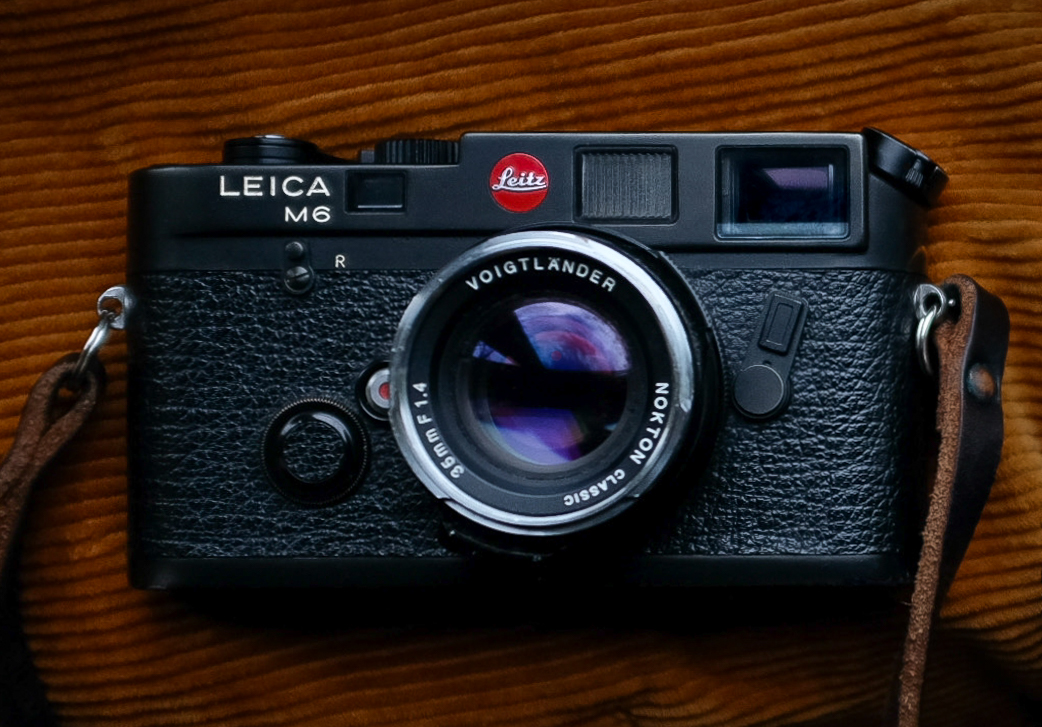
The Leica M6 — retroactively called the "M6 Classic" or "M6 non-TTL" after the 1998 M6 TTL successor — is the M body that brought the Leica M-system into the meter-equipped era while preserving the fully-mechanical character that defined the M3 and M4. Introduced in 1984 with a built-in TTL center-weighted light meter powered by silicon photodiodes and displayed via three LED arrows in the viewfinder, the M6 keeps everything else mechanical: cloth-curtain horizontal-travel shutter, all-mechanical timing, brass top and bottom plates, the same M-mount and brightline-frame viewfinder principles introduced 30 years earlier on the M3.[1][2] Approximately 175,000 units were produced over the 1984–1998 main run — making the M6 the second-most-produced M body after the M3.
For photographers buying into the M system today, the M6 is the consensus first-camera recommendation: meter for shooters who want one, mechanical core for shooters who want the M experience, and the most affordable serviceable Leica M body on the used market. Whether the M6 Classic or the later M6 TTL is the "right" version is a personal call — most experienced Leica users prefer the Classic for its smaller top plate and conventional shutter dial direction; flash-intensive shooters prefer the TTL for its TTL flash control.
Construction and build
- Body dimensions — 138 × 77 × 33.5 mm (matching the M3/M4 footprint).[2]
- Body weight — 560–585 g depending on source (Wikipedia cites 585 g; Camera-Wiki cites 560 g).
- Cloth horizontal-travel focal-plane shutter — speeds 1 s through 1/1000 s plus B. Mechanical timing — the meter's electronics are independent of the shutter mechanism. A dead battery does not disable the camera — only the meter stops working.
- X-flash sync at 1/50 s.
- Materials — die-cast brass top and bottom plates (with chrome or black-chrome plating), vulcanite covering, chrome trim. Same construction quality lineage as the M3/M4.
The M6 is the last fully mechanical M body before the M7 introduced electronic shutter timing in 2002. Photographers who specifically value mechanical operation often hold this as the M6's trump card.
Production locations
- Wetzlar, Germany (1984–1986) — the end of the historical Wetzlar era for Leica. Very early M6 bodies carry the "Wetzlar" engraving and command modest collector premiums.
- Solms, Germany (1986–1998) — Leica's new headquarters following the move from Wetzlar. The bulk of M6 production. Bodies engraved "Solms" or unmarked-location.
The Wetzlar/Solms split has minimal mechanical or optical impact (production methods didn't change meaningfully); the engraving and the collector premium are the practical difference.
The TTL meter
The single feature that distinguishes the M6 from earlier M bodies is the built-in light meter:[1]
- Sensor type — silicon photodiode (SPD), TTL center-weighted, reading off a white dot painted on the shutter curtain (the same off-the-film metering principle Olympus used on the OM-2, but here applied to the curtain rather than the film itself).
- Metering pattern — center-weighted average; the white-dot reading area sits roughly in the central 13mm of the frame.
- Display — three red LED arrows in the viewfinder, visible alongside the rangefinder patch:
- ▲ (left) lit alone: scene is overexposed at the current settings; reduce aperture or shutter speed.
- ● (center) lit alone: correct exposure.
- ▼ (right) lit alone: scene is underexposed; increase aperture or shutter speed.
- Two LEDs lit (e.g., ▲● or ●▼): exposure is between full stops; bias toward the brighter LED.
- ISO range — 6 to 6400, set on the back-of-body dial.[2]
- Activation — the meter activates with a half-press of the shutter release; releases automatically after several seconds of inactivity to preserve battery.
The meter is manual-only — there is no aperture-priority or shutter-priority autoexposure on the M6 Classic. The photographer reads the LEDs and sets aperture and shutter speed manually. This is faster in practice than it sounds: the LED display is in the viewfinder, so metering and composing happen simultaneously.
Battery
- 2× SR44 silver-oxide button cells (the standard) or 1× 1/3N lithium cell (alternative).[2]
- Battery powers only the meter. Shutter operation is fully mechanical and independent.
- Typical battery life: roughly a year of moderate use, longer with sparing meter use.
Viewfinder and rangefinder
The M6 was offered in three viewfinder magnification variants across the 1984–1998 production:[1]
- 0.72× — the historical default and the most common variant. Frameline pairs: 28+90, 35+135, 50+75. Covers all current M-system focal lengths from 28mm up.
- 0.85× — telephoto-friendly. Limited production (M6J 1994 50th-anniversary 1,640-unit run; later 0.85 standard production from 1998 onward). Frameline pairs: 35+135, 50+75, 90 alone. The 28mm frameline is omitted because it would not fit comfortably in the higher-magnification view.
- 0.58× — wide-angle-friendly. Limited production (later M6 era). Frameline pairs: 28+90, 35+135, 50+75 with the 28mm frame more comfortable in the larger view.
Most M6 buyers choose 0.72× as the default; 0.85× appeals to 50/90mm-primary shooters; 0.58× appeals to 28/35mm-primary shooters and eyeglasses wearers (the wider eyepoint suits people whose eye sits further from the eyepiece).
Rangefinder geometry:
- Base length — 49.9 mm (slightly longer than the M3/M4's 47.1 mm).
- Effective rangefinder base at 0.72× magnification — 35.9 mm. Adequate for any normal-aperture lens; fast 50mm and 90mm lenses approach the precision threshold but are still workable.
Frameline preview lever
A small lever on the front of the body left of the lens mount. Move the lever and the viewfinder frameline switches to a chosen focal length pair regardless of the mounted lens. Useful for scouting compositions before mounting a different lens — a feature absent on the M3/M4 that the M6 introduced.
Special variants and limited editions
The M6 had more limited-edition / commemorative production than any other M body in history:
- M6 Classic (standard) — chrome and black-chrome finishes, 0.72× standard. The bulk of production.
- M6 Wetzlar (1984–1986) — early production with Wetzlar engraving. Modest collector premium.
- M6J (1994) — 1,640-unit 50th-anniversary edition with the 0.85× viewfinder introduced. Anthracite finish, "150 Jahre Optische Werke" engraving, leather case included.
- M6 LHSA editions (Leica Historical Society of America) — small commemorative runs, typically 200–500 units each, in various finishes (titanium-look, gold, brass, etc.).
- M6 Titanium (1992) — titanium finish, ostrich-leather covering. A few thousand units.
- M6 Platinum / Gold / various commemoratives — extremely small numbers, deep collector territory.
The standard chrome and black-chrome M6 Classic accounts for ~95% of total M6 production; commemorative editions trade at significant premiums to standard bodies.
Lens system context
Same Leica M-mount as every M body. Frameline display covers 28, 35, 50, 75, 90, 135 mm (paired display selected by mounted lens or via the preview lever). All M-mount lenses ever made work on the M6 with full mechanical functionality.
Working notes
- The meter is the headline feature. Most photographers who shoot M6 use the meter daily; some use it as a sanity check on hand-held meter readings.
- Battery dependency is meter-only. A dead battery is not a camera failure — switch to sunny-16 or hand-held metering.
- Self-timer — mechanical, ~8–12 second delay, lever on the front of the body.
- Frameline preview lever — useful for shot-planning before changing lenses.
- Common service items on a 25+-year-old body: shutter timing drift on slow speeds (CLA fix), rangefinder alignment, light seal replacement, meter-circuit faults (rare; if present, often a fix to the LED array or the meter switch). Leica specialist CLA: $300–500.
- Wind lever feel — the M6 wind is generally smoother than the M3/M4 (the manufacturing process matured). Bodies with rougher wind feel may need lubrication service.
Used market and reliability
- Chrome M6 Classic (Solms, 1986–1998) — body only, working condition: $2,500–4,000 (US 2026 pricing). The most-recommended first M.
- Black-chrome M6 Classic — body only, working condition: $2,800–4,500. Slightly higher than chrome due to perceived (and minor) collector preference.
- M6 Wetzlar (1984–1986) — body only, working condition: $3,200–5,000. Wetzlar engraving premium.
- M6J (1994) — body only, working condition: $8,000–12,000+. Anniversary edition; collector territory.
- M6 Titanium (1992) — body only, working condition: $4,000–7,000. Premium finish, smaller production.
- M6 LHSA editions — body only, working condition: $5,000–15,000+ depending on edition. Collector territory.
- 2022 M6 reissue — Leica relaunched M6 production in October 2022 based on the MP's mechanical internals styled to look like an early M6. Trades at retail (~$5,295 new) or slightly under on the used market. Mechanically a different camera from the 1984–1998 M6 Classic; visually nearly identical.[2]
Buying-checklist items: rangefinder accuracy, shutter speed timing, light seal condition, shutter curtain integrity (same as M3/M4), plus meter circuit operation (test all ISO settings; verify LED display is consistent across the range).
Related cameras
- Leica M3 — the founding M body; mechanical core shared but no meter
- Leica M4 — the M3's successor; same mechanical core, no meter, rapid-load and angled rewind
- Leica M6 TTL — the 1998–2002 successor with TTL flash, taller top plate, reversed shutter dial
External references
- Leica M6 (Camera-Wiki) — community-edited reference for specifications, viewfinder magnification variants, and metering details
- Leica M6 (Wikipedia) — production history including 2022 reissue context
References
- WEB Leica M6 Camera-Wiki. https://camera-wiki.org/wiki/Leica_M6 ↩
- WEB Leica M6 Wikipedia. https://en.wikipedia.org/wiki/Leica_M6 ↩