Linhof Technika V
Overview
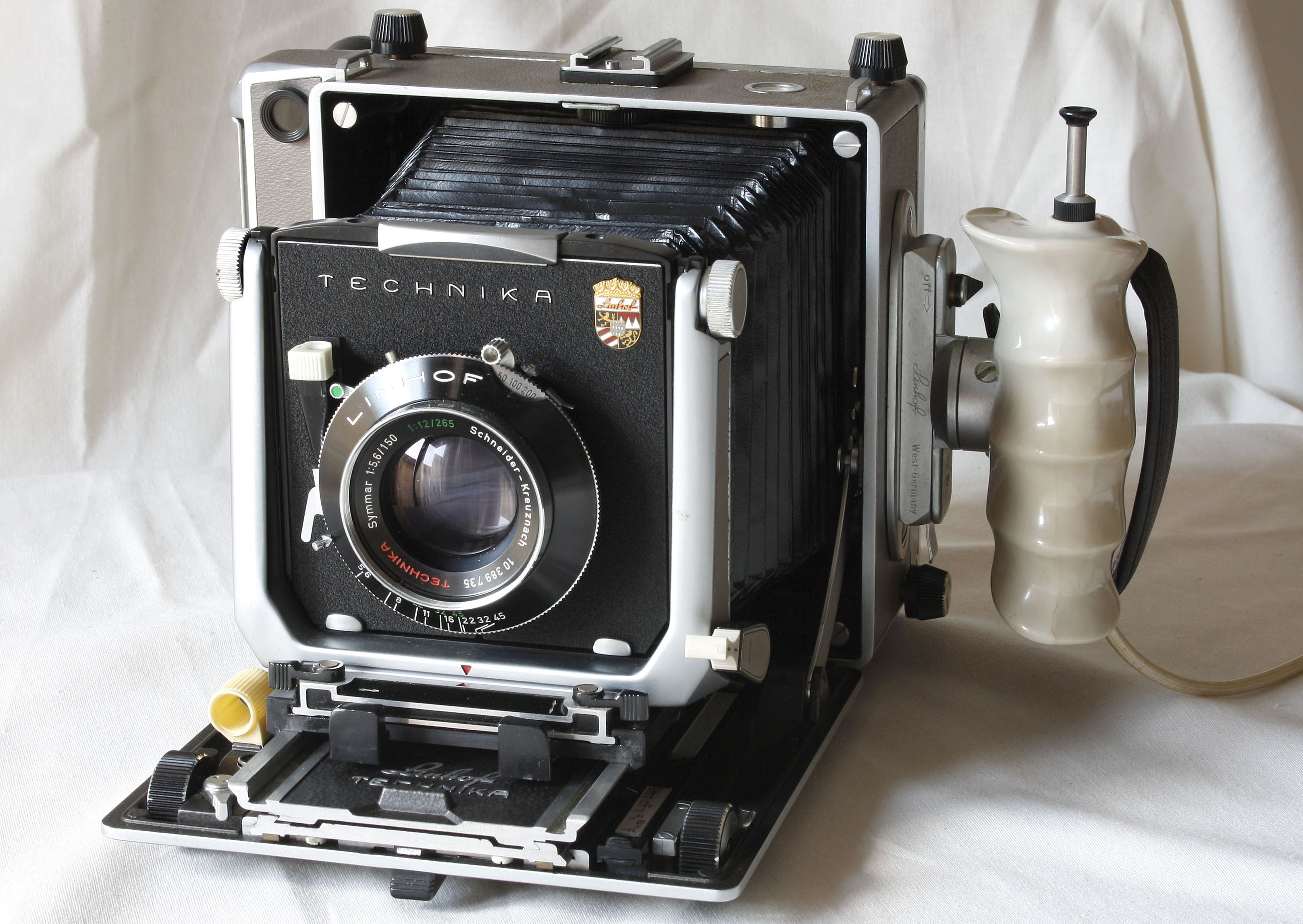
The Linhof Technika V (also called Super Technika V when fitted with the rangefinder system, which is essentially all working V bodies) is the fifth-generation 4×5 folding press camera in Linhof's flagship Technika lineage — a refinement of the Super Technika IV (1956–1964) that established the modern Technika movement specifications and remained in production through the 1970s and into the 1980s alongside the Master Technika (1972–present).[1] Production years vary by source: this row cites 1968–1983; broader literature commonly cites the mid-1960s for introduction with sub-variant production continuing into the 1980s. The Master Technika eventually displaced the Technika V at the high end of Linhof's product line, but Linhof continued V production for a meaningful overlap period as the more accessible price-point Technika.
For 4×5 photographers buying into the Technika system today, the Technika V is the most affordable authentic Technika on the used market — body+rangefinder kits trade $1,200–2,800 vs. $1,800–4,500 for a comparable Linhof Master Technika Classic, while delivering essentially the same mechanical capabilities (movements, rangefinder, lens-cam system, multi-format roll-film masking). The trade-offs vs. the Master Technika are subtle: slightly less refined focusing helicoid action, slightly less precise rear-standard movement detents, and access to a smaller lens-cam factory service path (Linhof still cams lenses for Master Technika today; Technika V camming is generally handled by specialists like Marflex).
Construction and build
- All-metal folding body — the lens standard folds flat against the camera body for transport. Closed dimensions roughly 18 × 18 × 11 cm.[2]
- Body weight — approximately 2,500–2,700 g (similar to the Master Technika's 2,600 g without lens).
- Materials — die-cast aluminum and brass throughout, leatherette body covering, satin chrome trim. The all-metal construction makes the camera dense in hand (heavier than wood-folding-field cameras) but delivers exceptional rigidity.
- Format — 4×5 inch primary; viewfinder masks and Linhof-Rollex / Super-Rollex roll-film backs enable 9×12 cm, 6×9, 6×7, and (with the right back) 6×12 panoramic.
The Technika V's build philosophy is "tool-grade" — designed for working press photographers and view-camera professionals who would use the body for decades. CLA service is straightforward via Linhof specialists; a 50+-year-old Technika V is commonly in everyday use.
Distinguishing features (vs. Super Technika IV)
The V's refinements over the IV:[1]
- Improved door-strut attachment — the springs that hold the dropbed in position were moved inside the body, vs. the IV's external springs. Reduces transport-collapse failure modes.
- Metal shims under ground glass with revised Fresnel-lens placement — improved viewing-screen-to-film-plane accuracy. Earlier Technika III and IV used cardboard shims that could compress over time.
- Refined dropbed click-stop mechanism — more precise and durable detents than the IV.
- Updated lens-cam system — the V's lens-cam interface was iteratively refined for greater rangefinder accuracy across the working focal-length range.
- Compatible accessory range — the V uses the same Linhof accessory ecosystem (lens boards, viewfinders, roll-film backs, focusing hoods) that the Master Technika continued. A Technika V buyer benefits from the still-in-production accessory supply.
Movements and dropbed
Same fundamental movement architecture as the Master Technika:
- Front standard rise/fall — geared, smooth, ~55 mm range.
- Front standard shift — geared, ~40 mm each side.
- Front standard tilt — front lens-center tilt 30° forward and backward, click-stop at neutral.
- Front standard swing — 15°.
- Rear standard swing/tilt — 20° in all directions on later V production; earlier sub-revisions had narrower rear movements.
- Dropbed click-stops — 15°, 30°, 55° forward, lockable. The dropbed enables wide-angle lens use without bellows compression and provides limited bed-tilt movement when the lens standard is angled relative to the bed.
The geared front movements with millimeter-scale readouts on rise and shift make multi-exposure registration reliable — a feature shared with the Master Technika.
Rangefinder and lens-cam system
The Technika V's distinguishing feature for press / photojournalism work is the coupled rangefinder mounted on the side of the body:[1]
- Mechanical coupled rangefinder — small viewfinder window with split-image focus indicator. Driven mechanically by a cam on each cammed lens.
- Lens-cammed-to-body system — each lens used with the rangefinder must be cammed at the factory or by a Linhof specialist to the specific body. A "cammed" 150mm lens carries a metal cam that drives the body's rangefinder mechanism; the cam is shaped to match the body's serial number. Up to three lenses can be cammed per body.
- Uncammed lenses still work for ground-glass-only operation; the rangefinder simply doesn't function for those lenses.
- Universal Optical Viewfinder — Linhof's accessory finder system uses interchangeable masks for different focal lengths and formats (4×5 50mm wide, 4×5 90mm normal, 4×5 150mm portrait, plus 6×7 / 6×9 / 9×12 cm masks for roll-film work).
For handheld photojournalism, the rangefinder + cammed lens + Universal Optical Viewfinder combination makes the Technika V function similarly to a 35mm rangefinder camera — focus through the rangefinder, frame through the viewfinder, fire the shutter. For tripod / studio work, the photographer flips up the ground-glass back and uses traditional view-camera methods.
Lens system
The Technika V uses Linhof's square-recessed lens-board system — lenses are mounted in Compur or Copal shutters and bolted to a Linhof Technika lens board. Each lens board is interchangeable on any Technika body (and on Linhof Kardan monorails with adapter), so a Technika lens kit translates across the entire Linhof system.
Working focal lengths typically cammed for the Technika V:
- 65mm Super-Angulon f/8 — wide-angle (covers 4×5 with movements via dropbed)
- 75mm Super-Angulon f/8 or f/5.6 — moderate wide
- 90mm Super-Angulon f/8 or f/5.6 — wide-normal
- 150mm Symmar / Sironar / Nikkor-W — the standard "kit" normal
- 180mm or 210mm — portrait / short-tele
- 240mm Symmar or Apo-Symmar — short telephoto
- 270mm or 360mm Tele-Xenar / Tele-Arton / Apo-Ronar — telephoto (the Technika's bellows-draw-limited maximum at standard configuration is around 360mm)
The Linhof-recommended lens lineup at the time covered Schneider, Rodenstock, and Nikkor optics; modern Technika V users source lenses from the same lineage plus contemporary Apo-Sironar-S and Apo-Symmar-L options.
Working notes
- Battery dependency: none. The body and shutter are fully mechanical (the in-lens shutter has no electronics). The rangefinder is mechanical. A working Technika V needs no batteries.
- Lens removal — release the lens-board lock at the top of the lens standard, slide the board upward, and lift it off. Reverse to install.
- Multi-format roll-film backs — Linhof Rollex / Super-Rollex backs slide into the back interface in place of the ground-glass; the Universal Optical Viewfinder gives framing for the chosen format.
- The dropbed must be lowered to its first click-stop (15°) before opening the lens standard — otherwise the standard will not extend properly. Memorize this sequence to avoid frustration during setup.
- Common service items on a 50+-year-old body: bellows pinholes (can be patched or replaced; Linhof still sells replacement bellows), focusing-helicoid lubricant breakdown (CLA fix), rangefinder calibration (specialist adjustment), light seals at the back interface, dropbed strut spring tension. Linhof specialist CLA: $400–700 typically; bellows replacement adds $300–500.
Used market and reliability
- Technika V body only (no rangefinder, no roll-film back) — working condition: $700–1,400 (US 2026 pricing).
- Technika V body + standard 4×5 ground-glass back + 1 cammed 150mm lens + Universal Optical Viewfinder — working condition: $1,200–2,200. The most-recommended kit configuration.
- Technika V body + 2–3 cammed lenses (90mm + 150mm + 240mm) + Universal Optical Viewfinder + roll-film back — working condition: $1,800–2,800. Fully-equipped kit.
The Technika V trades for less than the Master Technika because the V is out of production and accessory service is somewhat less straightforward (Linhof still cams lenses for Master Technika today; Technika V camming is more often via Marflex or other specialists).
Common buying-checklist items: bellows light-tight integrity (point at a bright light with the back open; look for pinholes), rangefinder accuracy (focus a cammed lens at infinity and at minimum-focus distance; both should align), focusing-helicoid smoothness, dropbed strut tension, ground-glass condition (cracks render the body essentially useless until replacement).
Related cameras
- Linhof Master Technika — the 1972 successor; still produced in 2026 as the Master Technika Classic; refined version of the V's design philosophy
- Sinar Norma — the canonical 4×5 monorail; different design philosophy (modular vs. folding), different working style (studio-centric vs. press-camera portability)
- Sinar F2 — Sinar's lightweight monorail; closer in weight to the Technika V
External references
- Linhof Master Technika Classic (Linhof official) — manufacturer's product page for the V's successor, useful for understanding the modern-day Technika design refinements
- Linhof (Wikipedia) — company history and Technika lineage
- Classic Cameras: Linhof Super Technika V (B&H eXplora) — practitioner review with historical context
References
- WEB Classic Cameras: Linhof Super Technika V B&H Photo Video. https://www.bhphotovideo.com/explora/photography/hands-on-review/classic-cameras-linhof-super-technika-v ↩
- WEB Linhof Wikipedia. https://en.wikipedia.org/wiki/Linhof ↩