Sinar Norma
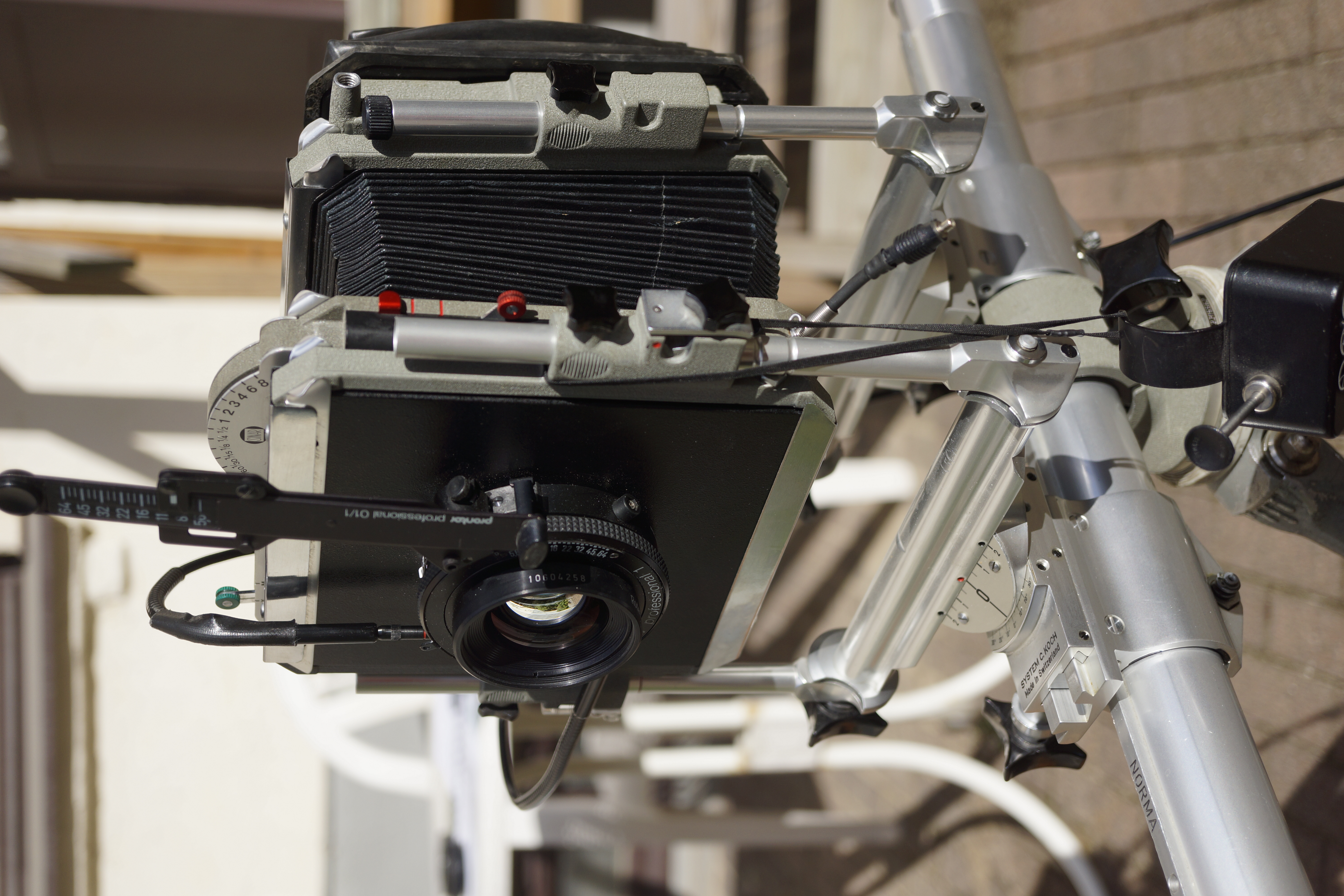
Overview
The Sinar Norma is the founding camera of the Sinar modular view-camera system and one of the most historically significant large-format cameras ever built. Designed by Carl Koch and introduced in 1948 in Schaffhausen, Switzerland, the Norma established the design paradigm that has defined Sinar's product line for over 75 years: a rigid monorail body with swappable front and rear standards, interchangeable lens boards, bellows, and backs.[1] Production ran through the 1990s with periodic revisions; units from any decade of production remain functional and collectible today.
Construction and build
The Norma's defining characteristic is its all-metal construction. Where earlier field cameras relied on wood and brass, the Norma used precision-machined aluminum and steel throughout. This made it significantly heavier than contemporary field cameras (~6 kg vs typical field-camera 3–4 kg) but delivered exceptional rigidity — movements, once set, stay set. No flex under bellows tension, no drift during long exposures, no slop in the rail clamps.
The build philosophy was "tool-like" — the Norma was designed for daily professional use in studios and commercial photography departments, not delicate field work. This heritage of rigidity and durability is what distinguishes the Norma (and Sinar generally) from its wood-folding-field-camera competitors.
Movements — manual, precise, and tactile
The Norma's movements are all manual — rise, fall, shift, tilt, and swing on both front and rear standards, with friction-locked hinges and no gearing. This is the design's most distinctive difference from the later F2 (basic geared movements) and P2 (fully-geared throughout):
- Rise/fall and shift — hand-adjusted; lock via knurled knobs
- Tilt and swing — hand-adjusted; lock via large thumb-knobs on each hinge
- No micrometer-scale readouts — movements are visual/tactile, not numerical
This manual character suits photographers who prefer mechanical feel over photography-by-the-numbers. Studio photographers shooting catalog/product work often preferred the P2's geared precision for reproducibility across setups; landscape and documentary photographers often preferred the Norma's tactile response.
Lens board and bellows compatibility
The Norma uses the Sinar-standard 140mm square lens board — interchangeable with every Sinar camera from the 1948 original through the 2008-discontinued P2 and F2. A lens mounted on a Sinar board in 1960 works on a P2 in 2010 without adaptation. This 60+ year compatibility is the core promise of the Sinar system.
Bellows are similarly interchangeable: the Norma accepts standard bellows (50–450mm draw), bag bellows for wide-angle lenses (50–100mm without kinking), and long bellows extensions for 300–500mm lenses via rail extensions.
Format capabilities
Native 4×5 format via Graflex-type spring-back or Sinar's own back system. 5×7 and 8×10 conversion kits extend the camera to larger formats (different back + lens board + bellows combinations). Sinar's modular design makes these format conversions practical without requiring a second camera body.
Bellows draw range
50–450mm standard draw; extendable via rail extensions for long focal lengths. This range covers:
- Wide-angle lenses from 65mm (bag bellows) to 150mm
- Normal lenses (150–240mm) at comfortable mid-range draw
- Long lenses up to 300mm at full extension; 360mm with rail extension
Historical significance
The Norma's place in photography history is substantial. Famous users include:
- Walker Evans — later editorial and studio work after 1948 used Sinar cameras; his earlier and best-known FSA documentary work (1935–1938) pre-dates the Norma and was shot on other 8×10 systems
- Bernd and Hilla Becher — their typological architectural series (water towers, industrial structures) was shot almost entirely on Sinar cameras including Normas
- Generations of European commercial photographers — the Norma was the de facto standard in German, Swiss, and French studios from the 1950s through the 1990s
The Becher School (Bernd and Hilla Becher + their Düsseldorf students like Thomas Struth, Andreas Gursky, Candida Höfer, Thomas Ruff) in particular relied on Sinar cameras for their rigorous typological approach to architectural photography.
Use case recommendations
- Studio work with tactile preferences — photographers who prefer hand-adjusted movements over geared precision
- Heritage-motivated work — photographers who want the classic Sinar experience for aesthetic or historical reasons
- Documentary and architectural work at moderate pace — the Norma's rigidity makes it reliable for long multi-exposure workflows
- Budget-conscious entry into the Sinar system — used Normas are the most affordable path into the modular ecosystem
Not ideal for:
- Rapid location work (weight + setup time)
- Studio product work requiring reproducibility across setups (P2 preferred)
- Photographers needing micrometer-scale movement readouts (P2 preferred)
Comparison with sibling Sinar models
- Sinar F2 — lighter (5.5 kg vs 6 kg), basic geared movements, more portable. Better for field/location work.
- Sinar P2 — heavier (8 kg), fully-geared movements with micrometer readouts, asymmetric-tilt geometry, metering back capability. The studio reference.
The Norma sits between the F2 (lighter) and P2 (more precise) in the Sinar lineup — its unique position is the manual-movement workflow and historical significance. If you want geared precision, choose the P2; if you want portability, choose the F2; if you want the classic Sinar experience with all-manual movements, choose the Norma.
Comparison with non-Sinar alternatives
- Linhof Technika (folding field camera) — more portable; less rigid; narrower movement range. Different design philosophy.
- Toyo 45AII — Japanese metal folding field camera; lighter; similar movement range; much less expensive used
- Wista 45VX — Japanese wood/metal field camera; traditional aesthetic; similar capabilities
- Horseman LX — Japanese monorail; comparable to Sinar F2 in concept; less expensive
The Norma's distinctive position: all-metal rigidity + Sinar-system compatibility + classic manual-movement workflow.
Discontinuation and used market
The Sinar Norma was produced through the 1990s with periodic revisions. Sinar transitioned production focus to the F2 and P2 lines in the 1980s, with the Norma remaining in the catalog until the late 1990s.
Used-market pricing (2026):
- Excellent condition, recent service: $1500–2000
- Good condition, functional: $800–1500
- Fair condition or needs attention: $500–800
The Norma's all-metal construction means it holds up well — decades-old units in working order are common. Service items to check: bellows light-tightness (original bellows may have developed pinholes), clamping knobs (check they still lock firmly), rail connection integrity.
Scheimpflug and focus theory
Like all Sinar cameras, the Norma supports full Scheimpflug focus adjustment — tilting the front or rear standard to align the plane of focus with the subject plane. Merklinger's hinge-rule analysis applies: the hinge line forms at the front nodal point; knowing this enables precise tilt-for-focus workflow. The Norma's manual tilt hinges lack the geared precision of the P2, but skilled practitioners achieve the same results through iterative adjustment.[1]
See Hyperfocal Distance for related focus theory and [[merklinger-focusing-the-view-camera]] for the full view-camera focus workflow.
Accessories and system upgrade paths
Every Sinar accessory compatible with the P2 or F2 is compatible with the Norma — lens boards, bellows, backs, rails, viewing hoods, multi-format adapters. Photographers can start with a Norma body and build out the Sinar system over time; the only excluded accessory is the Sinarsix/Booster metering back (which requires P2-specific electrical contacts).
Related cameras and techniques
- Sinar F2, Sinar P2 — sibling Sinar models
- Fujinon AS 240mm f/9 — LF lens compatible with the Sinar lens board
- Hyperfocal Distance — focus theory applicable to all view-camera work
References
- BOOK Focusing the View Camera Seaboard Publishing. ISBN 978-0-9695025-2-4. http://www.trenholm.org/hmmerk/ ↩