Sinar P2
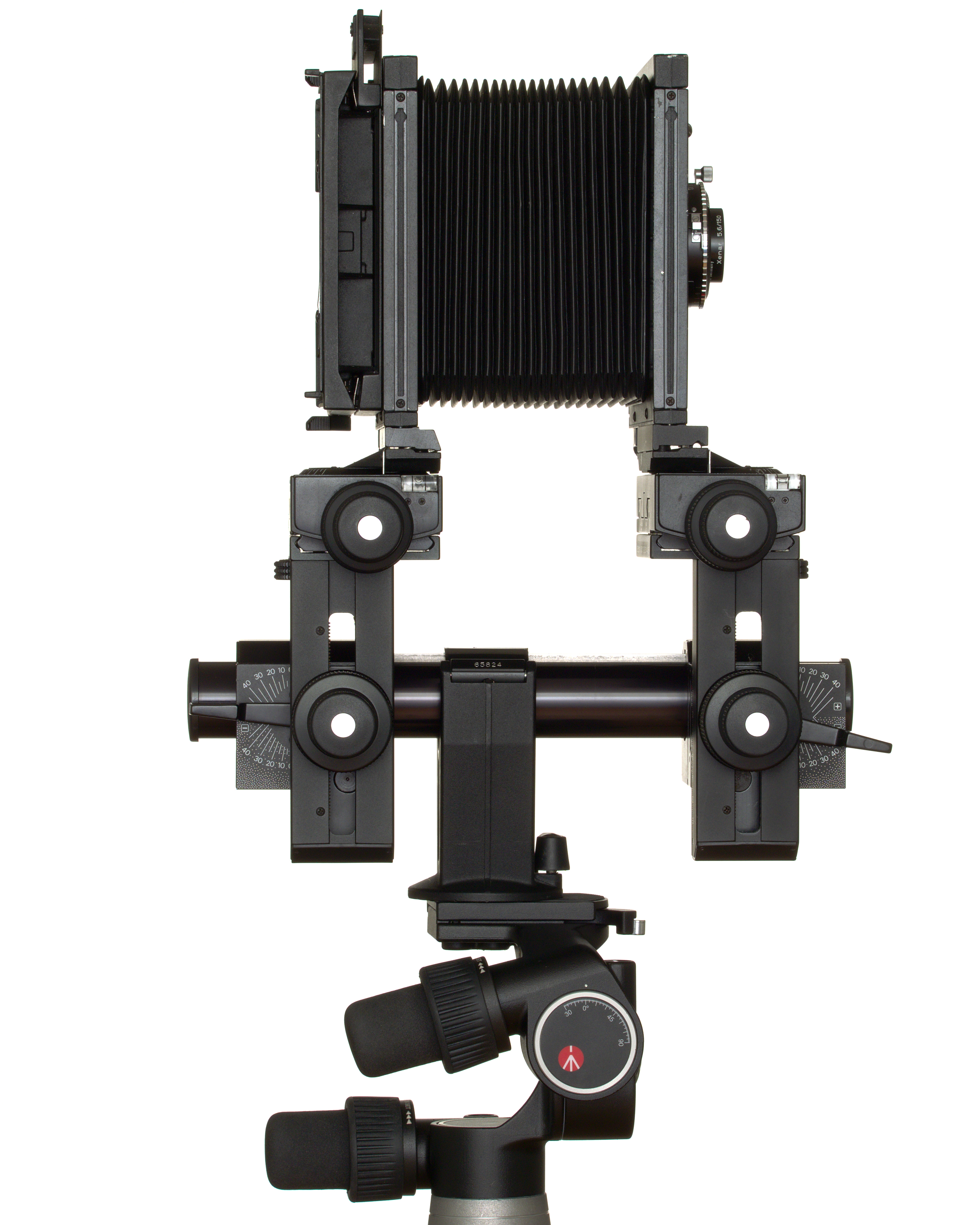
Overview
The Sinar P2 is the reference studio large-format camera of the late film era — the camera that high-end commercial photographers reached for when absolute precision, reproducibility, and geared movement workflow mattered most. Introduced in 1988 as a refinement of the earlier Sinar P (1971), the P2 offered fully-geared movements throughout, Sinar's distinctive asymmetric yaw-free tilt geometry, and native compatibility with electronic metering backs (Booster, Sinarsix, and later Sinarsix-P).[1] Production ran until 2008, when Sinar transitioned away from analog camera production.
Construction and build
The P2 weighs approximately 8 kg body-only (without bellows or lens), making it the heaviest of the Sinar monorail line and reflecting its "studio reference" positioning. The weight comes from:
- Heavily-machined all-metal construction throughout; no polymer components
- Massive rail clamping system with triple-locking geometry
- Geared mechanism housings on every movement axis (vs F2's mixed geared/manual configuration)
- Larger bellows frames supporting up to 600mm draw
- Reinforced standards sized for 8×10 conversion
The build philosophy is "no compromise" — the P2 is over-built for 4×5 work to ensure it remains rigid even with the full bellows extension to 600mm, large format backs attached, and tripods that may be less than perfectly stable. The practical result: movements once set stay set with zero drift, even under long multi-exposure workflows.
Movements — fully geared with asymmetric yaw-free tilt
The P2's defining feature is its fully-geared movement system with micrometer-scale readouts on every axis:
- Rise and fall — geared with millimeter-scale readout; repeat adjustment exactly for multi-exposure workflows
- Shift — geared, millimeter-scale readout
- Tilt — geared with degree-scale readout; asymmetric pivot point for yaw-free geometry
- Swing — geared with degree-scale readout; same asymmetric pivot design
The asymmetric tilt geometry deserves specific attention. On a conventional view camera (including Norma, F2, and most non-Sinar cameras), the tilt pivot point is at the center of the standard's frame. Tilting the front standard introduces unwanted shift of the lens axis — the lens effectively moves up or down as it tilts, requiring re-composition of the frame after tilting. This is the "yaw" problem.
The P2 places tilt pivot points off-center — specifically at the optical axis of a typical lens mounted on a Sinar lens board. The result: tilting the front standard pivots the lens around its own optical center, and the lens axis (and thus the image projected onto the ground glass) doesn't shift laterally. Front tilt for Scheimpflug compliance doesn't disturb composition. This is the yaw-free design.
For photographers doing architectural work, product photography, or any workflow where composition is set first and focus-plane adjustment follows, yaw-free tilt means tilting for focus doesn't require recomposing — a significant workflow advantage.
Metering back capability
The P2 was engineered to accept Sinar's Booster and Sinarsix metering backs — devices that replace the film back temporarily for through-the-lens spot metering. Workflow:
- Set up composition and focus on ground glass
- Close aperture and insert metering back in place of film holder
- Move probe across the focused ground-glass image; meter reads density at each probe position
- Set shutter based on integrated or spot-point meter readings
- Replace metering back with film holder; shoot
This workflow is the "studio product photography" reference standard. Commercial photographers shooting catalogs and advertisements in the 1990s and 2000s relied on Booster/Sinarsix integration with the P2 for repeatable, accurately-exposed multi-frame setups.
The Norma and F2 do not accept metering backs — a distinctive P2-only feature and a key reason commercial/catalog photographers chose the P2 over the F2.
Lens board and bellows compatibility
Like all Sinar cameras, the P2 uses the Sinar-standard 140mm square lens board. Full compatibility with lens boards, bellows, backs, and accessories from 60+ years of Sinar system products. A lens mounted on a Sinar board in 1955 works on a P2 in 2008.
Bellows interchangeability: standard, bag (wide-angle), and long extension bellows all fit the P2. Bellows draw range 50–600mm (the maximum in the Sinar line).
Format capabilities
Native 4×5 format. Conversion to 5×7 and 8×10 via specific back + lens-board + bellows combinations. The P2's larger body sizes the 8×10 conversion cleaner than on the F2; many 8×10 commercial photographers use the P2 as their primary camera with the 8×10 conversion installed semi-permanently.
Bellows draw range
50–600mm — the longest in the Sinar monorail line. This covers:
- Wide-angle lenses from 58mm (bag bellows required)
- Normal lenses (150–240mm)
- Long lenses up to 480mm with standard bellows extension
- 480–600mm with full rail extension
Long bellows support is important for studio product photography at close focus distances (macro and 1:1 reproduction) — the 600mm maximum is often necessary at those distances even with 300mm lenses.
Use case recommendations
The P2 is the studio reference camera. Specific strengths:
- Studio product photography — the geared movements and asymmetric tilt are exactly suited to precision catalog work; metering-back integration closes the exposure-workflow loop
- Architectural interiors and exteriors — the yaw-free geometry makes tilt-for-focus non-disruptive; micrometer readouts allow precise vertical-line correction
- Commercial fashion and still-life — the repeatability across setups supports high-volume multi-setup shoots
- Fine art / large-format landscape (in studio style) — photographers like Andreas Gursky and Thomas Struth shot extensively with Sinar P-series cameras for their methodical typological approach
- Macro and reproduction work — 600mm bellows draw + apochromatic lenses + yaw-free tilt = peak technical capability
Not ideal for:
- Location/field work (the 8 kg + tripod + accessories weight makes it impractical for long hikes or fast-paced location shoots — F2 preferred)
- Photographers new to view-camera workflow (the P2's capabilities exceed beginner needs; F2 or Norma would be kinder learning cameras)
- Budget-conscious entry (used P2 pricing is 2–4× F2 pricing; save the money for lenses)
Comparison with sibling Sinar models
- Sinar Norma — older design; manual (not geared) movements throughout; lighter than P2 (~6 kg vs 8 kg); no metering back support. The classic Sinar, not the studio reference.
- Sinar F2 — lighter (5.5 kg vs 8 kg); basic geared rise/fall/shift; manual tilt/swing; no metering back. The portability compromise.
The P2 is the no-compromise studio camera in the Sinar line. If you need maximum precision and don't mind the weight/price, it's the obvious choice; if either portability or budget is a constraint, the F2 is the practical alternative with the same lens-board/bellows ecosystem.
Comparison with non-Sinar alternatives
- Linhof Kardan Master GTL — German monorail competitor at similar price; similar feature set; marginally different tilt geometry (not asymmetric yaw-free)
- Arca-Swiss F-Line Classic — premium monorail with rotating tilt; different workflow than Sinar's linear geared movements; comparable precision
- Cambo Ultima — Dutch/American monorail; premium; similar class to P2; less expensive
- Linhof Technika — folding field camera; different design philosophy (portable folding vs rigid monorail); not a direct competitor for studio work
Among premium monorails, the Sinar P2's distinctive strength is the asymmetric yaw-free tilt + integrated metering-back system. Arca-Swiss matches the precision but uses different tilt geometry; Linhof Kardan matches the build quality but without metering-back integration.
Discontinuation and used market
Sinar discontinued the P2 in 2008. Used-market pricing (2026) reflects the P2's premium positioning:
- Excellent condition with accessories (bellows, lens boards, ground glass): $5000–8000
- Good condition, functional: $3500–5000
- Fair condition or needing service: $2500–3500
- Body-only, good condition: $3000–4500
P2 units with Sinarsix or Booster metering backs command a premium (+$800–1500 for the metering back alone). Service items to check: bellows light-tightness (original bellows after 15+ years often need replacement — Sinar still sold replacement bellows through secondary suppliers), gear mechanism smoothness on all axes (particularly tilt and swing where manufacturing variance was high), lens board clamp integrity, micrometer readout calibration (verify with a known-distance test).
The P2's value retention is exceptional. Units purchased new in the 1990s for ~$5000 USD still sell for $3000–5000 in 2026 — a remarkable performance for 30+ year old equipment, reflecting the camera's continued reputation and the absence of a true modern successor product.
Scheimpflug and focus theory
The P2's asymmetric yaw-free tilt geometry is the canonical example of Merklinger's hinge-rule principle executed cleanly. The tilt pivot placement aligns with the lens's front nodal point, making the hinge-line behavior predictable: the hinge forms at the lens's aperture iris regardless of tilt amount. Merklinger's calculations (tilt angle, hinge-line distance, subject-plane orientation) apply directly without complications from unwanted shift.
For photographers new to view-camera focus workflow, the P2's yaw-free design makes tilt-for-focus teaching easier: tilt doesn't cause unwanted lateral shift, so the cognitive separation between "what's in focus" (tilt controls) and "what's in frame" (shift controls) is cleaner than on cameras with standard tilt geometry.[1]
See Hyperfocal Distance for related focus theory.
Accessories and system upgrade paths
Every Sinar system accessory works on the P2: lens boards, bellows (standard/bag/extension), backs (4×5/5×7/8×10), rails, viewing hoods, multi-format adapters, Booster/Sinarsix metering backs (P2-only feature), Sinar Handy film-back handles, fresnel ground glass options, spirit levels, fine-focus knobs, rotating backs.
Photographers owning both an F2 and a P2 split usage by context (F2 for location, P2 for studio) with all lens boards, bellows, and 4×5 backs shared between them — the Sinar system's practical workflow advantage.
Related cameras and techniques
- Sinar Norma, Sinar F2 — sibling Sinar models
- Fujinon AS 240mm f/9 — LF lens commonly paired with the P2 for studio work
- Hyperfocal Distance — focus theory applicable to all view-camera work; Merklinger's hinge rule is particularly cleanly implemented on the P2
References
- BOOK Focusing the View Camera Seaboard Publishing. ISBN 978-0-9695025-2-4. http://www.trenholm.org/hmmerk/ ↩