Ilford Delta 400
Characteristics
- Grain: fine
- Contrast: medium
- Latitude: wide
- Formats available: 35mm, 120
Overview
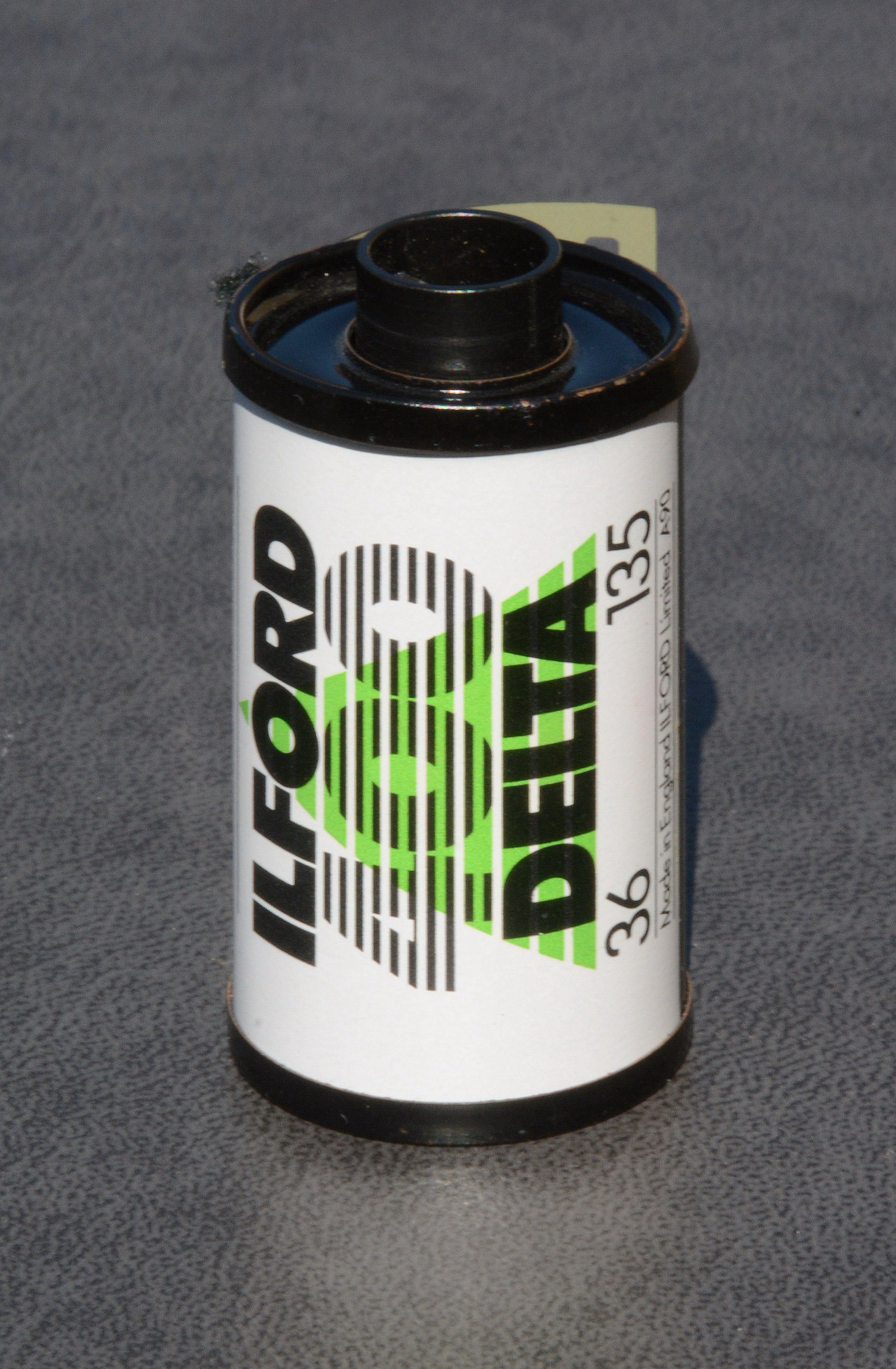
Ilford Delta 400 Professional is Ilford's T-grain-equivalent black-and-white film at ISO 400, introduced in 1991 as Ilford's response to Kodak's T-Max series. The "Delta" name refers to the triangular (Δ-shaped) tabular grain crystal structure — the same technology Kodak brands as "T-grain." Delta 400 occupies a distinctive position in the ISO 400 B&W landscape: finer grain than cubic-grain stocks (HP5 Plus, Tri-X) with a cooler, more neutral tonality than Tri-X's warm bias, and modest improvements in reciprocity behavior over older-technology films.[1]
The Delta emulsion line
Ilford produces Delta-series films at three ISO ratings:
- Delta 100 — finer grain, slower; landscape and pictorial
- Delta 400 (this film) — the middle; general-purpose fast B&W
- Delta 3200 — specialized high-speed for low-light work
All three share the tabular-grain architecture that gives the line its name. The Delta family is Ilford's answer to Kodak's T-Max, and the two lines are direct competitors across their ISO ranges.
T-grain structure and its practical effect
Ilford's Delta emulsion uses thin tabular silver halide crystals rather than the cubic crystals of traditional B&W films (HP5 Plus, Tri-X). Practical implications:
- Finer grain — per-stop, Delta 400 grain sits between Tri-X 400 (coarser) and Delta 100 (finer). RMS granularity ~10 vs Tri-X's ~17 and Delta 100's ~8.
- Higher resolution — the tabular structure captures more detail per unit area
- More neutral tonality — Delta lacks Tri-X's warm shadow bias; renders closer to neutral with subtle coolness in shadows
- Better reciprocity — tabular crystals respond more linearly at long exposures (exponent p ≈ 1.1 vs cubic stocks' 1.3)
This makes Delta 400 a natural choice for photographers who want the classic B&W aesthetic with finer grain than Tri-X/HP5+ while retaining genuine ISO 400 speed.
Exposure characteristics
Delta 400's rated box speed is EI 400; honest delivery at box speed is the baseline. Common ratings:
- EI 400 (box) — standard; reliable
- EI 320 — moderate overexposure for richer pictorial rendering (similar to Tri-X practice)
- EI 200 — generous overexposure; develop at box time for shadow-rich negatives
- EI 800–3200 — push territory
Push processing
Delta 400 pushes cleanly:
- EI 800 (+1) — minor grain increase; clean midtones
- EI 1600 (+2) — noticeable grain; strong contrast; classic push register
- EI 3200 (+3) — heavy grain; shadow detail significantly compromised. For EI 3200+ work, Ilford's dedicated Delta 3200 product is the proper tool (box-speed 3200 with larger grain but cleaner overall rendering than +3-pushed Delta 400)
Development workflows
Delta 400 pairs well with multiple developers:
- Ilford ID-11 1:1 — Ilford's matched standard developer; 12 min at 68°F for EI 400. Clean, fine grain.
- Ilford Microphen — speed-increasing developer; excellent push behavior. 9:30 stock at 68°F for EI 400.
- Ilford DD-X 1:4 — liquid concentrate; fine-grain. 8 min at 68°F for EI 400.
- Ilford Perceptol 1:1 — fine-grain compensating developer; for maximum grain reduction. 13 min at 68°F for EI 320 (Perceptol costs ~1/3 stop).
- Kodak HC-110 Dilution B — common substitute; 6:45 at 68°F for EI 400.
- Agfa Rodinal 1:50 — for maximum acutance; grain pronounced.
Reciprocity failure
Delta 400 has improved reciprocity over cubic-grain stocks — approximate Schwarzschild exponent p ≈ 1.1:
| Metered exposure | Actual exposure | Correction |
|---|---|---|
| 1s | ~1.2s | ~⅕ stop |
| 10s | ~12s | ~⅓ stop |
| 60s | ~1.5 min | ~1 stop |
About 3× better than Tri-X at comparable long exposures — making Delta 400 a preferred choice for astrophotography (when Acros II 100 isn't fast enough) and long-exposure landscape work.
See Reciprocity Failure Compensation for the full per-stock comparison table.[1]
Tonal palette — the Ilford neutral
Delta 400 renders with a neutral-to-slightly-cool tonal palette distinct from Kodak's warm Tri-X bias:
- Shadows — clean, slightly cool; less warm character than Tri-X or HP5+
- Midtones — smooth, well-separated; close to linear response
- Highlights — controlled bloom; less flare than Tri-X
- Grain — fine, structured, nearly invisible at normal scan resolutions
The overall impression sits between Tri-X's "journalistic" warmth and T-Max 400's somewhat cooler modern character — Delta 400 is "classically Ilford" with T-grain technology refinements.
Comparison with competitors
| Film | Grain | Tonal character | Push | Reciprocity |
|---|---|---|---|---|
| Delta 400 (this film) | Fine (T-grain) | Neutral Ilford | EI 1600 clean | p≈1.1 |
| Ilford HP5 Plus 400 | Medium (cubic) | Ilford-warm | EI 1600 clean | p≈1.3 |
| Kodak Tri-X 400 | Medium (cubic) | Warm classic | EI 1600 clean, EI 3200 usable | p≈1.3 |
| Kodak T-Max 400 | Fine (T-grain) | Cooler neutral | EI 1600 clean | p≈1.1 |
| Fuji Neopan 400 (discontinued) | Medium | Crisp neutral | Similar to HP5+ | Similar to T-Max 400 |
Delta 400's distinctive position: T-grain fineness + Ilford neutral palette + excellent long-exposure behavior. Photographers who prefer Tri-X/HP5 warmth look elsewhere; photographers who want modern technology with classic character stay with Delta.
Format availability
Harman Technology (Ilford's current owner) produces Delta 400 in:
- 35mm — 36-exposure cassettes, pro packs of 5
- 120 — 5-roll pro packs
- 4×5 sheet — 25-sheet boxes
No 8×10 offering. Pricing at Ilford's professional tier; typically 10–20% less than Kodak equivalents.
Workflow recommendations
- Street photography — EI 400 in HC-110 Dil B or Ilford DD-X; honest delivery; cleaner grain than Tri-X
- Portrait — EI 320 in Perceptol 1:1 for smoothest grain; Ilford's neutral palette flatters most complexions
- Landscape — EI 320 in ID-11 1:1; Delta 400 at sheet-film format excels for fine-detail landscape
- Available-light documentary — EI 1600 in Microphen; T-grain structure gives cleaner push result than cubic stocks
- Long-exposure work — EI 400; better reciprocity than Tri-X/HP5+; consider Acros II 100 for extreme long exposures
- Astrophotography — T-grain finer resolution than Tri-X for stellar imaging; better reciprocity too
Related films and techniques
- Kodak Tri-X 400 — cubic-grain contemporary; different tonal philosophy
- Fuji Neopan Acros II 100 — Fuji's SFG ultra-fine-grain alternative (slower)
- Push Processing — Delta 400 in the per-stock table
- Reciprocity Failure Compensation — Delta 400's near-linear reciprocity is a feature
References
- BOOK The Negative 1st ed. Little, Brown and Company, 1981. ISBN 0-8212-1131-5. ↩