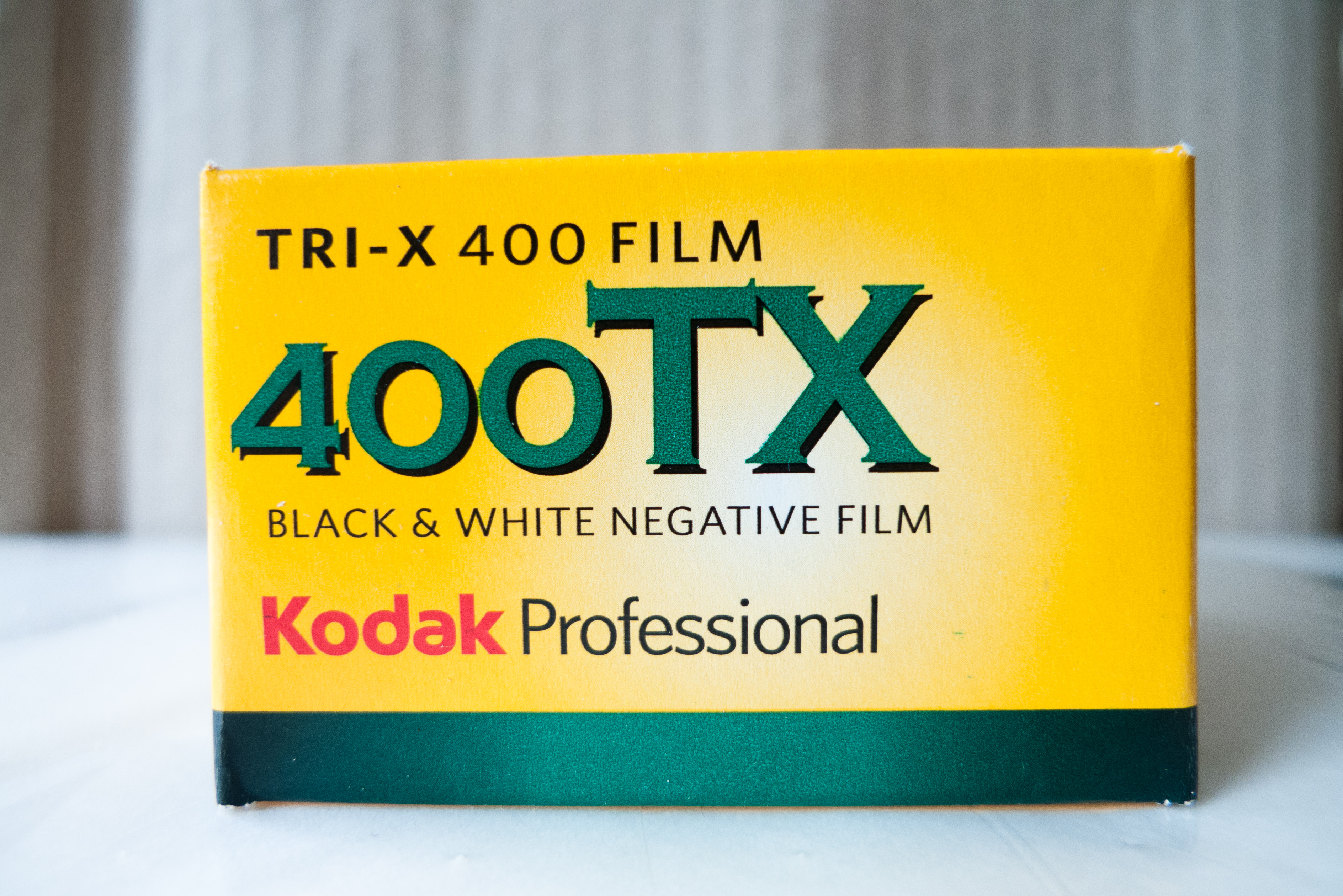
Kodak Tri-X 400
Characteristics
- Grain: medium
- Contrast: medium
- Latitude: wide
- Formats available: 35mm, 120, 4x5
Overview
Kodak Tri-X 400 is the oldest continuously-produced black-and-white film in the world and the most-shot fast B&W film in photographic history. Kodak introduced Tri-X in 1954, and despite multiple reformulations over seven decades, it remains the benchmark for fast cubic-grain B&W film. Tri-X defined the aesthetic of mid-20th-century photojournalism (Robert Frank's The Americans, Eugene Smith's Pittsburgh project), street photography (Garry Winogrand, Diane Arbus), and continues to dominate contemporary documentary and fine-art B&W work.[1]
Historical context
- 1954 — Tri-X 400 introduced. Original formulation rated at EI 400 with the newly-standardized ASA/ISO scale.
- 1970s–1990s — Multiple minor reformulations refining grain structure and spectral response while preserving the core Tri-X character.
- 2007 — "New Tri-X 400" (Kodak's formulation refresh). Marginally finer grain than older formulations; tonality preserved. Current production stock dates from this revision.
- 2013–2026 — Kodak Alaris (a British spinoff formed after Eastman Kodak's 2012 bankruptcy reorganization) handled distribution; manufacture remained at Eastman Kodak's Rochester, NY plant throughout.
- Present (since Jan 2026) — Eastman Kodak resumed direct distribution of Tri-X 400 alongside several other emulsions (Gold 200, UltraMax 400, Ektar 100, Ektachrome E100). Current-production packaging features the iconic red-and-yellow "K" Kodak logo, distinct from the Alaris-era "Kodak Professional" yellow wordmark. Available in 35mm, 120, 4×5, and 8×10 formats — one of the few remaining fast B&W films offered in sheet film.
The film's 70+ year continuous production is unmatched — no other current B&W stock has a comparable history.
Design philosophy — classic cubic grain
Tri-X uses Kodak's traditional cubic-grain emulsion technology (distinct from their newer T-grain tabular-crystal structure used in T-Max). Practical implications:
- Grain: visible and "character-building" — Tri-X grain is a feature, not a defect. Photographers choose Tri-X specifically for its grain texture at moderate enlargements.
- Forgiving latitude: ±2 stops exposure tolerance without visible quality loss. One of the most forgiving B&W films ever made.
- Warm tonal bias: shadows render with warm undertones (a Kodak-family trait); highlights bloom slightly
- Response curve: gentle S-shape; moderate contrast at box-speed development
Exposure characteristics
Tri-X 400's rated box speed is EI 400, but the film's practical behavior varies by photographer's preference:
- EI 400 (box) — honest box-speed delivery; optimal for average-contrast scenes
- EI 320 — common "pictorial" rating; 1/3-stop overexposure produces slightly richer midtones and shadow detail
- EI 250 — more aggressive overexposure for fine-art B&W work; develop at box time
- EI 800–3200 — push territory; see Push Processing section below
Many photographers consider EI 320 the "true" Tri-X speed for pictorial work — the film delivers optimal mid-tone rendering at this slightly overexposed rating.
Push processing — the canonical push film
Tri-X 400 is THE canonical push film — the example cited in virtually every push-processing discussion. Behavior:
- EI 800 (+1 push) — clean; minor grain increase, maintained shadow detail
- EI 1600 (+2 push) — classic street/documentary push register; Garry Winogrand's standard rating. Noticeable grain, some shadow compression, dramatic contrast
- EI 3200 (+3 push) — usable but heavy grain; shadow detail significantly compromised. Daido Moriyama's signature aesthetic uses Tri-X at EI 3200 or higher
- Beyond EI 3200 — gritty, high-contrast territory; practical ceiling for most photographers
See Push Processing for the general theory.
Development workflows
Tri-X is exceptionally accommodating across developers:
- Kodak D-76 1:1 — the classic pairing; 9:30 at 68°F for EI 400. Reliable, reproducible, moderate grain.
- Kodak HC-110 Dilution B — 5:45 at 68°F; convenient (one-shot concentrate, long shelf life); slightly more grain than D-76.
- Ilford Microphen — designed as a speed-increasing developer; 7:30 stock at 68°F for EI 400, or push to EI 800 without extended time. Preferred for push workflows.
- Kodak XTOL 1:1 — fine-grain alternative to D-76; 9:00 at 68°F for EI 400. Cleaner grain; slightly softer shadow detail.
- Agfa Rodinal 1:25 or 1:50 — maximum acutance; 9:00 at 68°F for 1:50. Grain is pronounced; sharpness impressive.
Reciprocity failure
Tri-X follows classic cubic-grain reciprocity behavior. Approximate Schwarzschild exponent: p ≈ 1.3.
| Metered exposure | Actual exposure | Correction |
|---|---|---|
| 1s | ~1.5s | +½ stop |
| 10s | ~30-50s | +1½ stops |
| 60s | 5-10 min | +3 stops |
See [[reciprocity-failure]] for the mechanism and Reciprocity Failure Compensation for the full per-stock comparison table.[1]
Tonal palette
Tri-X's signature: warm-leaning B&W rendering with forgiving tonal compression:
- Shadows — warm undertones; block up gracefully rather than sharply
- Midtones — creamy, gradual transitions; flatters skin
- Highlights — bloom slightly, which reads as "photographic" rather than digital-sharp
- Grain — visible, structured, tactile. Grain character varies with developer choice (Rodinal pronounced; XTOL subdued).
This is the "classic black-and-white film look" — what most people mean when they say B&W photography should look a certain way.
Comparison with competitors
| Film | Grain | Tonal character | Push latitude | Reciprocity |
|---|---|---|---|---|
| Tri-X 400 (this film) | Coarse, structured | Warm, classic | Excellent to EI 1600; usable to 3200 | Standard cubic p≈1.3 |
| Ilford HP5 Plus 400 | Similar | Ilford-warm | Similar; Microphen preferred | Similar p≈1.3 |
| Kodak T-Max 400 | Fine (T-grain) | Cooler, more modern | Excellent; different character | Better (p≈1.1) |
| Ilford Delta 400 | Fine (T-grain) | Neutral Ilford palette | Clean to EI 1600 | Better (p≈1.1) |
| Fuji Neopan 400 (discontinued) | Medium | Crisp neutral | Similar to HP5+ | Similar to T-Max 400 |
Tri-X's distinctive position: the most forgiving, most versatile, most "classic" option. Photographers who want fine grain or modern tonal character look elsewhere (T-Max or Delta); photographers who want The B&W Film Look stay with Tri-X.
Format availability
Tri-X 400 is currently available in:
- 35mm — 36-exposure cassettes, pro packs of 5
- 120 — 5-roll pro packs (no single-roll retail)
- 4×5 — 50-sheet boxes
- 8×10 — 25-sheet boxes
The 4×5 and 8×10 sheet formats are particularly notable — few fast B&W films are available in sheet today (T-Max 400 and HP5 Plus being the main alternatives).
Famous users and cultural impact
- Robert Frank — The Americans (1958); shot extensively on Tri-X at EI 400
- Garry Winogrand — street photography; Tri-X at EI 1600 push was his constant rating
- Diane Arbus — portraits, sometimes pushed, always Tri-X
- Daido Moriyama — the extreme-push aesthetic (EI 3200+); defined Japanese street photography
- Eugene Smith — Pittsburgh project (1955–58); Minamata (1971–75)
- Sebastião Salgado — extensive documentary/landscape work (though also used Tri-X's larger-format sheet equivalents)
Tri-X's cultural weight in photography exceeds any other film stock — it is implicitly "B&W film" in popular imagination.
Workflow recommendations per use case
- Street photography — EI 400 in HC-110 Dil B at 5:45; or EI 1600 in Microphen for the Winogrand push aesthetic
- Portrait — EI 320 (overexpose ¼ stop) in D-76 1:1 at 9:30; smoother skin rendering
- Landscape — EI 250 (overexpose ⅔ stop) in XTOL 1:1 at 9:00; cleaner grain at enlargement sizes
- Available-light documentary — EI 1600 in Microphen; accept grain + contrast as aesthetic
- Sheet film work — EI 400 in HC-110 Dil B or D-76 1:1; Tri-X's sheet formats excel for large-format B&W where grain is effectively invisible
Related films and techniques
- Push Processing — Tri-X's home territory
- Pull Processing — Tri-X pulls gracefully; worked beach-at-noon example uses HP5+ but Tri-X behaves similarly
- Reciprocity Failure Compensation — Tri-X is the baseline comparison in the per-stock table
- Zone System Exposure — Tri-X is the canonical Zone System B&W film
- Ilford Delta 400 — closest T-grain competitor
- Fuji Neopan 400 (discontinued) — discontinued alternative with crisp-neutral palette
References
- BOOK The Negative 1st ed. Little, Brown and Company, 1981. ISBN 0-8212-1131-5. ↩