The Sunny 16 Rule is a simple method for estimating correct daylight exposure without a light meter. On a sunny day, set your aperture to f/16 and your shutter speed to the reciprocal of the film's ISO. For example, with ISO 400 film, use f/16 at 1/400 s (or the nearest available speed — usually 1/500 s). This guideline has been used by photographers for decades and remains remarkably accurate because daylight itself is remarkably consistent

.[1]
Why it works
Direct sunlight at the Earth's surface produces an illuminance of roughly 120,000 lux, varying by less than one-third of a stop across most populated latitudes between mid-morning and late afternoon. Photographers call this condition
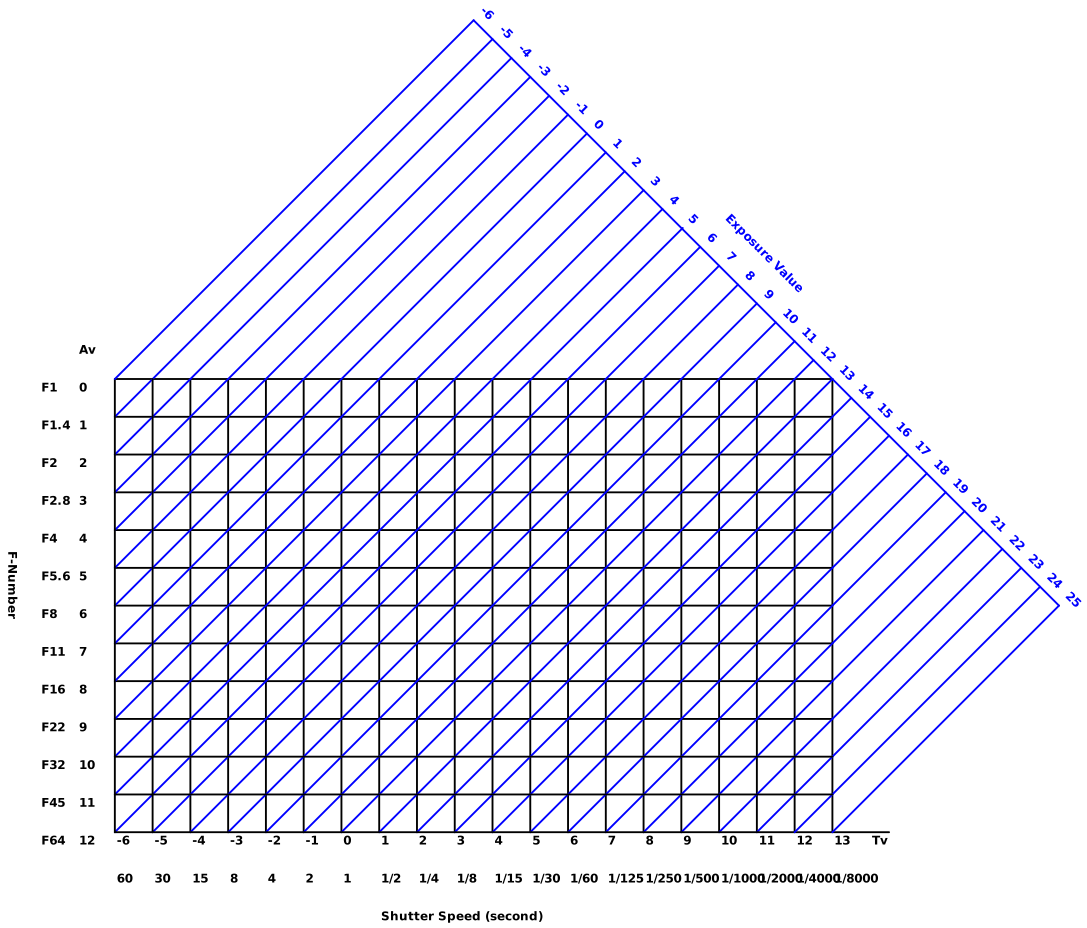
"EV 15" — exposure value 15 — and every integer on the EV scale is one stop (a doubling or halving) of exposure.
The specific f/16, 1/ISO combination is one natural solution to EV 15 at the film's base speed: at ISO 100, EV 15 works out to f/16 at 1/125 s; scale to any other ISO by adjusting the shutter speed to 1/ISO and the rule stays correct without needing to redo the arithmetic.[1] The mnemonic trades the EV math for direct memorization — which is exactly why it's a rule and not a formula.
Lighting Condition Adjustments
The base rule assumes bright, direct sunlight with distinct shadows. Adjust the aperture for other conditions, keeping the shutter speed fixed at 1/ISO:
- Bright sun, hard shadows: f/16
- Slight overcast, soft shadows: f/11
- Overcast, no shadows: f/8
- Heavy overcast or open shade: f/5.6
- Deep shade or sunset: f/4
Each stop wider compensates for approximately half the light level. Why adjust the aperture rather than the shutter? Convention — you could trade to slower shutters instead — but holding the shutter at 1/ISO simplifies the mnemonic: you only need to think about one value as conditions change.
For bright reflective scenes (snow on a sunny day, sand on a beach, glare on water) go the other direction — stop down to f/22 to compensate for the extra light the reflective surface adds. At very high altitudes, where the atmosphere attenuates less UV and visible light, stopping down half a stop beyond the base is also common.
Adjusting for film speed
Set the shutter to 1/ISO and leave the aperture at the base value for your condition. Common film speeds:
- ISO 100: f/16 at 1/100 s (or 1/125 s, the nearest standard speed)
- ISO 200: f/16 at 1/200 s (or 1/250 s)
- ISO 400: f/16 at 1/400 s (or 1/500 s)
- ISO 800: f/16 at 1/800 s (or 1/1000 s)
- ISO 3200: f/16 at 1/3200 s (or 1/4000 s)
If your shutter doesn't offer exactly 1/ISO — most shutters have whole- or half-stop increments — pick the nearest faster speed and the negative absorbs the small overexposure without trouble. Color and B&W negative films have roughly ±2 stops of latitude in either direction; slide film is much tighter (roughly ±1/2 stop) and deserves more care.
Related meter-less rules
Sunny 16 is the most widely-known

of a small family of meter-less exposure mnemonics. Each targets a specific lighting condition and packages a memorizable aperture/shutter combination:
| Rule | Condition | Aperture (shutter at 1/ISO) |
|---|---|---|
| Sunny 16 | Bright direct sun | f/16 |
| Looney 11 | Full moon (surface, not moonlit landscape) | f/11 |
| Moony 8 | Quarter moon (surface) | f/8 |
The Looney 11 rule applies when the moon itself is the subject — a tight telephoto shot, say. The moon's surface is sunlit and reflects approximately the same illuminance as a daylit scene on Earth, so the exposure is close to sunny-16. For landscapes lit by moonlight (where the moon is the light source, not the subject), exposures are vastly longer and reciprocity failure dominates the math; those are no longer meter-less territory.
When sunny-16 doesn't apply
Sunny 16 is strong for average-brightness daylight scenes. It quietly breaks down in four cases:
-
Very long exposures. At shutter speeds longer than about 1 second, film responds less than linearly to additional exposure — a phenomenon called reciprocity failure. A correctly estimated 10-second exposure on typical B&W film may need closer to 40 seconds to produce the expected density, and the correction is stock-specific. When sunny-16 reasoning extends into deep shade, twilight, or night photography, reach for manufacturer reciprocity tables (or bracket aggressively).
-
Very high-contrast scenes. Backlit subjects, spotlit stages, bright sky against dark foreground, stained glass — scenes with extreme brightness range benefit from spot metering specific tones and placing them on the tonal scale deliberately. Ansel Adams's Zone System approach is strictly better for these scenes; sunny-16 will expose for average brightness and clip the extremes.[1]
-
Slide / reversal film. Exposure latitude is roughly ±1/2 stop before visible degradation — half of what negative film tolerates. Estimation errors that a negative would absorb invisibly leave slides noticeably off. If slide film is loaded, bracket in 1/2-stop increments around your sunny-16 estimate.
-
Non-sunlight artificial sources. Tungsten, fluorescent, sodium-vapor, and mixed artificial lighting vary in intensity by factors of hundreds between scenes. There is no meter-less rule for indoor or night-street photography that approaches sunny-16's reliability outdoors.
Why it still matters
Even with cameras that have built-in meters, understanding sunny 16 builds exposure intuition. If your meter battery dies, you can still shoot confidently. It is also valuable when using fully manual cameras like the Pentax K1000 or older rangefinders that lack metering altogether.
More broadly, meter-less practice teaches you to read light with your eyes rather than through a reflected-light meter. That eye-read calibration makes you a better meter user too — experienced photographers often estimate first, meter second, and treat a large disagreement as a signal to reassess (highly-contrasty subject? reflective background? meter mis-reading a dominant bright tone?).
Tips for accuracy
- Lean on latitude. Negative film — especially Kodak Portra 400 and Kodak Tri-X 400 — has substantial exposure latitude, so sunny-16 estimates are more than sufficient for routine shooting. Slide film is less forgiving; bracket when in doubt.
- Stop down at high altitudes or near water and snow. UV and visible light are more intense; a half to full stop smaller than the base sunny-16 value keeps highlights controlled.
- Open up in the golden hour. During the hour after sunrise or before sunset the sun is traveling through more atmosphere and is much dimmer than its mid-day brightness. Open up one to two stops from the base sunny exposure, and keep opening further as the light continues to drop into twilight.
- Expose for the shadows on negative film. If the scene has important shadow detail, err by a half stop toward overexposure — the highlights on a negative will usually absorb it, and you'll preserve the shadow separation that a tight exposure would lose.
- Cross-check with a meter if one is handy. Sunny 16 is a rule of thumb; a meter is a measurement. Both have their place, and the practitioner who treats them as complementary rather than adversarial outperforms the practitioner who insists on one or the other.
With pinhole or zone-plate optics, sunny-16 is the starting point — you then apply the pinhole's typical f/180–f/300 effective aperture as a 6–8-stop adjustment. See Pinhole Photography.