Kodak Portra 800
Characteristics
- Grain: medium
- Contrast: low
- Latitude: wide
- Formats available: 35mm, 120
Overview
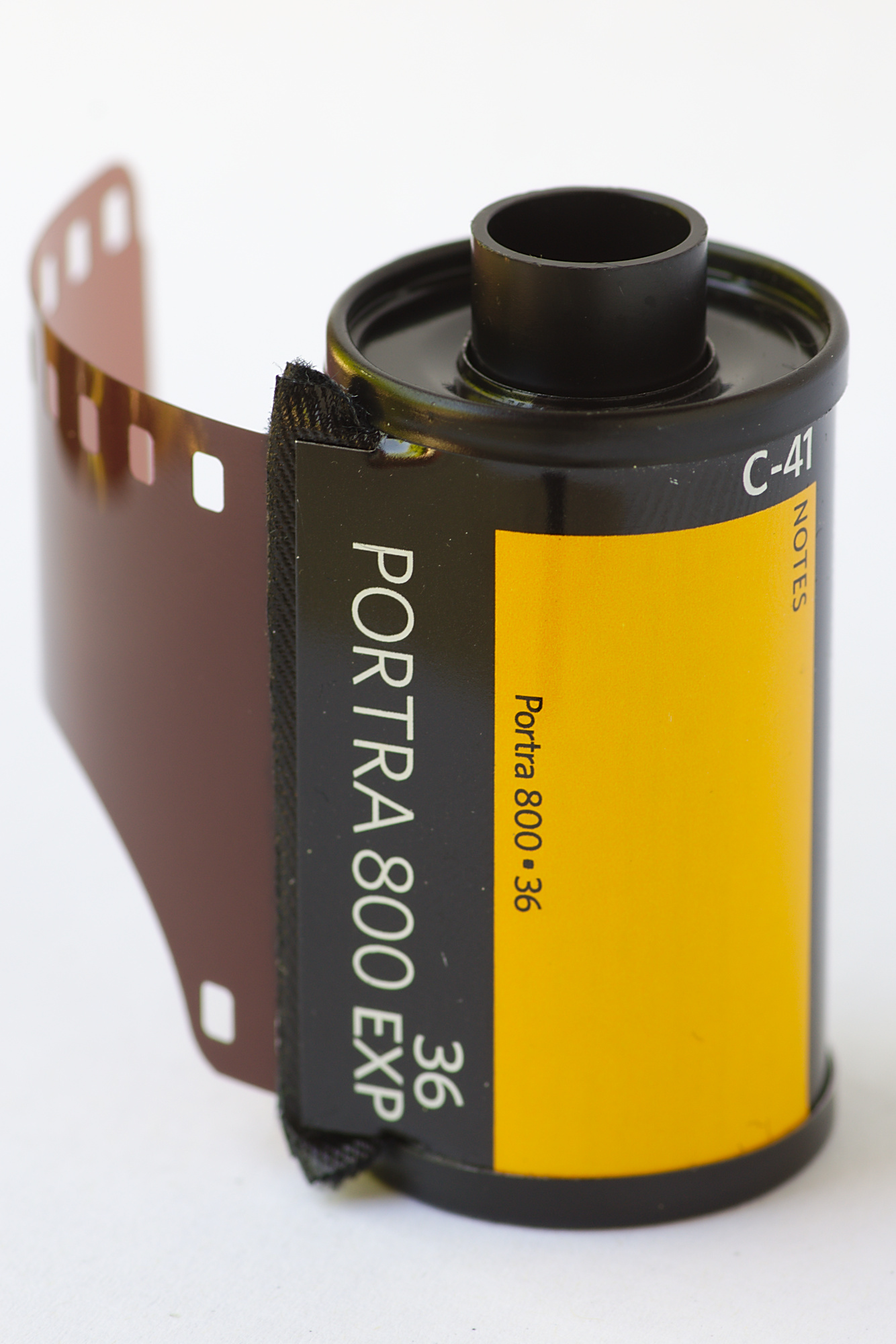
Kodak Portra 800 is the fastest member of Kodak's professional color negative line (Portra 160 / 400 / 800). Originally introduced in 1998 alongside Portra 160 and 400, with the current formulation dating from the 2010 Portra family-wide refresh, Portra 800 shares its siblings' hallmark traits — natural skin tones with a slight warmth, muted saturation compared to consumer stocks, and the flat S-shaped characteristic curve that gives Portra its famous wide exposure latitude. At ISO 800, it's the go-to color negative film for situations where 400-speed film runs out of light: weddings, concerts, overcast sports, available-light portraiture, night street.[1]
Intended use cases
Portra 800 was engineered for specific shooting scenarios where 400-speed film is half a stop too slow and flash is unwanted or impossible:
- Wedding receptions — indoor tungsten + window light, handheld, subjects in motion. EI 800 gives you 1/60s at f/2.8 in most reception halls.
- Concerts and theatre — stage lighting (uneven, often mixed color temperature), subjects moving, flash forbidden. Portra 800's wide latitude tolerates the inherent over/under-exposure in bracketing.
- Overcast and rainy-day outdoor work — daylight dropping below EV 13; Portra 800 recovers shooting speed without the exaggerated grain of pushed 400-speed.
- Available-light indoor portraiture — churches, cafes, studios without strobes. Warm ambient light is Portra's ideal palette.
- Night street photography — when pushing Tri-X to EI 1600 is the B&W answer, Portra 800 is the color answer. The color casts of mixed sodium/neon/LED sources become creative rather than technical problems.
Exposure latitude — the "rate at EI 400" workflow
Portra 800's most-discussed practical feature is its unusually wide highlight latitude (~5 stops over) and moderate shadow latitude (~2 stops under). This asymmetry makes Portra 800 fundamentally tolerant of overexposure and intolerant of underexposure — the exact opposite of reversal (slide) film.
Many Portra 800 shooters exploit this by rating the film at EI 400 (effectively a one-stop over-exposure) and printing or scanning the result as a normal negative. The effects:
- Finer apparent grain — more silver density per scene value means smoother grain on scan or print
- Richer midtones — shadow detail lifts well clear of the toe, so midtones get more tonal separation
- Cleaner highlights — overexposure slides bright values up into the shoulder's gentle flattening, which color negative's wide shoulder handles gracefully
- Color fidelity preserved — unlike with reversal film, overexposing Portra 800 by a stop produces no color shift
The practical workflow: set your meter to ISO 400 (or meter at ISO 800 and deliberately expose one stop over), develop normally in C-41, and scan or print. This is a Portra-family ritual, not specifically a Portra 800 trick — but it's worth knowing because internet advice for Portra 800 is often framed around this workflow.
Downside: you lose the "fast" advantage. Rating Portra 800 at EI 400 means you're back to 400-speed handholding limits. Keep it at box speed when you actually need the light.
Push processing
Portra 800 pushes cleanly to EI 1600 (+1 stop) with moderate color shifts — typically a slight warming across midtones. Push development time extends by roughly 30% in C-41 if the lab offers pushed color; few commercial C-41 labs push, so this often requires a specialty lab or a home E-6/C-41 setup.
+2 push (EI 3200) is feasible but color casts become aggressive (further warming and a visible magenta shift in shadows); at this point the aesthetic read is more "pushed color film look" than "natural color."
+3 push (EI 6400) or beyond is rarely clean. If you need light levels beyond +2 on color negative, switch films (Portra 800's competitor Cinestill 800T is tungsten-balanced, which helps at night) or accept B&W push via Tri-X or HP5 Plus.
See Push Processing for the general theory.
Grain and resolution
Portra 800 uses a proprietary grain structure (Kodak's T-grain-like technology, though not technically "T-grain" — that trademark applies to T-Max films). The result is meaningfully finer grain than a box-speed 800 ISO rating would suggest — closer to what you'd expect from a 400-speed film of the 1990s.
Per-format grain behavior:
- 35mm — grain visible at 2400–4000 DPI scans; grain is well-structured and "pleasant" rather than mushy; enlarges to 8×10 or 11×14 print sizes with the grain texture as aesthetic, not distraction
- 120 — grain nearly invisible at normal print sizes (8×10 from a 6×6 crop); 16×20 prints show texture but remain clean
- 4×5 and larger — not available (Kodak does not currently produce Portra in sheet format)
At high scanning resolutions (6000+ DPI on 35mm, 4000+ DPI on 120), grain resolution can exceed what commercial printing reproduces, which is why scan-for-web vs scan-for-print choices matter more for Portra than for finer-grained stocks like Portra 400.
Color palette and skin tones
Portra 800 shares the Portra-family signature: natural skin tones with a slight warmth, muted saturation vs consumer films (Kodak Gold, Ultramax), and well-separated reds and greens. Specific palette notes:
- Skin tones — rendered with natural warmth that flatters most complexions; Portra's particular gift, and the reason it dominates wedding photography
- Warmth — slight global warmth (more than Ektar 100, less than Gold 200); rendered consistently across exposure latitude
- Saturation — deliberately restrained; Portra is not a "pop" film. Reds, greens, and blues all sit closer to accurate than punchy
- Shadows — retain color detail well; shadows don't crush to black the way slide film does
- Highlights — roll off gracefully; skin highlights don't burn out to paper white even with significant overexposure
Comparison: Fuji Pro 400H (discontinued 2021) was Portra's long-time competitor in wedding/portrait work with a slightly cooler, greener palette. Cinestill 800T is tungsten-balanced, dramatically different for daylight (appears blue-green without filtration). Lomography Color Negative 800 is consumer-grade, much more saturated, less consistent batch-to-batch.
Reciprocity failure
Portra 800 follows standard color negative reciprocity behavior: compensation starting around 1 second metered exposure, with visible color shifts at long durations.
Representative compensation (approximate; consult Kodak datasheet E-4050 for definitive values):
- 1 second metered — no significant correction needed
- 10 seconds metered — ~1 stop additional exposure; slight magenta cast begins
- 60 seconds metered — ~2 stops additional; visible magenta shift; consider CC05G or CC10G filtration to counter
- 5+ minutes — bracketed testing recommended; color casts are film-batch and scene-dependent
See [[reciprocity-failure]] for the underlying mechanism (slow photons, thermal unfixing, curve-toe bending) and Reciprocity Failure Compensation for the full per-stock workflow including order-of-operations with ND filters.[1]
For color-critical long-exposure work (night cityscape with intentional accurate color), filter correction matters: a weak green CC05G corrects the magenta shift that accumulates beyond 30 seconds. For creative/street work, the color shift is often a feature.
Scanning
Portra 800's wide latitude makes it forgiving of scanner exposure settings — auto-settings typically produce usable scans on dedicated film scanners (Noritsu, Frontier, Epson V850) and flatbed scanners alike. Specific considerations:
- Density range — heavy overexposure (rated at EI 200 or below) can produce negatives whose density range exceeds lower-end flatbed scanner dynamic range; dedicated film scanners handle this without issue
- Color accuracy — Portra scans with minimal color correction needed; most scanner software's "auto color" produces defensible results, unlike with reversal stocks which need manual profiling
- Grain at scan resolution — at 4000+ DPI scanning, grain becomes visible; below 2400 DPI it smooths away. Match scan resolution to intended output size
- Dust and defect visibility — the warm palette tends to mask small dust particles that would be obvious on cooler stocks; but infrared-dust-removal features (ICE) work correctly with Portra as a color negative film
C-41 processing
Portra 800 develops in standard C-41 chemistry alongside any other color negative film. No special considerations:
- Standard time-temperature (3:15 at 37.8°C / 100°F)
- Standard agitation (initial 30s, then 5s per 30s thereafter for tank processing)
- Standard bleach, fix, stabilizer/rinse
- No special push times required at box speed
Commercial labs process Portra 800 at C-41 parity. For home processing, Cinestill Cs41 or Tetenal Colortec kits handle Portra alongside any other C-41 film.
Comparison with related films
| Film | ISO | Grain | Palette | Use case |
|---|---|---|---|---|
| Portra 800 (Kodak, current) | 800 | Medium | Natural warm, muted | Low-light portrait, reception, concert |
| Portra 400 (Kodak, current) | 400 | Fine | Natural warm, muted | Daylight + indoor portrait, wedding |
| Cinestill 800T (Cinestill, current) | 800 | Medium+ | Tungsten-balanced | Night city, neon, mixed artificial light |
| Fuji Pro 800Z (discontinued 2016) | 800 | Medium | Cooler, finer grain | Historical alternative to Portra 800 |
| Lomography Color Negative 800 (current) | 800 | Visible | Saturated, consumer | Experimental, cheaper |
Cinestill 800T is the direct daylight-balanced/tungsten-balanced contrast to Portra 800 at the same speed — if you shoot predominantly under artificial light sources, Cinestill 800T is the more accurate tool; Portra 800 gives warmer-leaning daylight accuracy and slightly less overt color fun.
Availability and format
As of 2026, Kodak produces Portra 800 in two formats:
- 35mm — 36-exposure cassettes, sold individually or in 5-roll pro packs
- 120 — 5-roll pro packs (no single-roll retail)
No 4×5 or 8×10 sheet offering. No 220 (longer 120-format rolls, phased out).
Pricing sits at Kodak's professional tier — typically 50–80% more per roll than Gold 200 or Ultramax 400 at mainstream retail; discount pricing from reputable sellers (B&H, Freestyle, Analogue Wonderland) brings per-roll cost down 15–25%.
Shelf life: refrigerate for 2+ years from manufacture; freeze for 5+ years. Room-temperature storage is acceptable for ~6 months but color shifts begin within a year.
Workflow recommendations
Concrete starting points per use case:
- Wedding reception — rate at box speed (EI 800), shoot at f/2.8 to f/4, shutter 1/60 to 1/125. Accept mild tungsten warmth — it flatters skin. Pack a second body with Portra 400 for outdoor ceremony shots.
- Concert / theatre — rate at EI 800, shoot wide open (f/1.4 or f/2), 1/125s minimum to freeze motion. Meter off the spot-lit performer, accept shadow color shifts. Consider +1 push if shutter speeds drop below 1/60.
- Available-light portrait — rate at EI 400 (overexpose ritual) for richer midtones; shoot at f/2 to f/5.6 depending on DoF goal; meter for shadow detail on face.
- Overcast outdoor — rate at box speed EI 800, shoot f/5.6 to f/8 at 1/250 to 1/500. Portra 800 is engineered for this exact scene.
- Night street — rate at EI 800, shoot wide open, 1/60s minimum handheld, brace or use tripod for longer. Bracket on interesting subjects. Accept mixed-light color casts as character.
Related techniques and films
- Push Processing — EI 1600 push workflow for Portra 800
- Reciprocity Failure Compensation — for long-exposure Portra 800 work
- Zone System Exposure — applicable to color negative via overexposure-toward-shadow-placement workflow
- Kodak Portra 400 — the one-stop-slower sibling
References
- BOOK The Negative 1st ed. Little, Brown and Company, 1981. ISBN 0-8212-1131-5. ↩