Kodak Technical Pan
Characteristics
- Grain: fine
- Contrast: high
- Latitude: narrow
- Formats available: 35mm
Overview
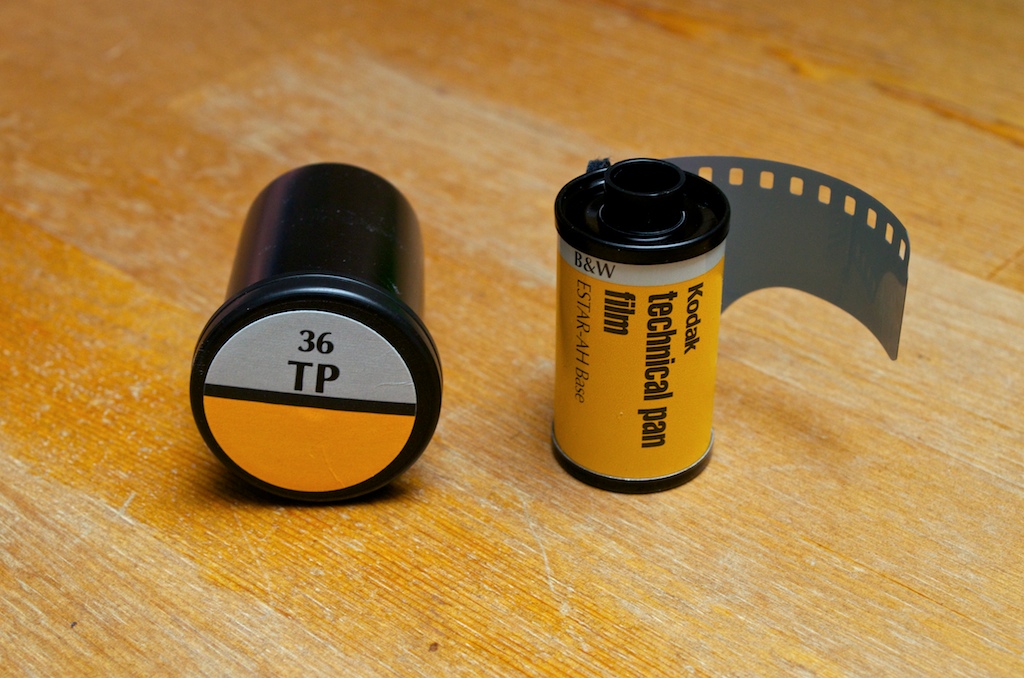
Kodak Technical Pan Film 2415 was a specialty black-and-white panchromatic 35mm film manufactured by Kodak from 1977 through 2004. It was engineered for scientific and technical markets — photomicrography, aerial reconnaissance, copy work for document preservation, high-resolution astrophotography — and was never marketed to pictorial photographers by Kodak. Its discovery by landscape and fine-art photographers in the 1980s and 1990s was an accident of adaptation that defined the stock's pictorial reputation.[1]
Tech Pan's technical specifications were extraordinary: 320 lines/mm resolving power (vs Tri-X's 50 lp/mm), RMS grain value of 8 (among the finest grain ever commercially manufactured), and extended red sensitivity reaching into the near-infrared. These numbers aren't marketing claims; they were measurable laboratory specifications.
The scientific origin
Tech Pan entered Kodak's catalog in 1977 alongside a line of scientific emulsions: Kodak SO-339 aerial reconnaissance film, Kodak Estar polyester-base documents films, and various photomicrography stocks. The target markets were:
- Aerial reconnaissance — military and intelligence agencies needed ultra-high-resolution panchromatic film for long-range cameras; Tech Pan's 320 lp/mm resolving power was the practical ceiling of 35mm film technology.
- Photomicrography — biologists and materials scientists used Tech Pan on microscope-mounted 35mm cameras to photograph slides, cell cultures, and material samples at sub-cellular detail levels.
- Document copy work — archivists and photoreproduction departments used Tech Pan for high-contrast duplication of text, line drawings, and technical diagrams.
- Astrophotography — amateur and professional astronomers used Tech Pan on long-exposure stellar imaging for the same reason military reconnaissance did: resolution. The film's ability to resolve closely-spaced stars made it the standard stellar imaging emulsion through the 1990s.
None of these markets overlapped with pictorial photography. Kodak priced Tech Pan at a premium, packaged it in scientific-oriented labeling (Kodak's "Professional" brand for pictorial use vs Tech Pan's unlabeled-generic-scientific feel), and never advertised it in consumer or amateur photography publications.
The dual-identity — one film, two aesthetics
Tech Pan's signature practical story: with different developers, the same film rendered two entirely different aesthetics. This was the result of Tech Pan's steep characteristic curve, which could be controlled (tamed) or enhanced (exploited) by developer choice:
Aesthetic 1: Full-gradation pictorial (with Technidol)
Kodak produced a proprietary Technidol Liquid Developer specifically to soften Tech Pan's naturally aggressive response curve for pictorial use. In Technidol at box speed EI 25, the film rendered with a full 9-zone tonal gradation — effectively a normal-contrast B&W pictorial stock, but with the resolution and grain of a scientific film. This was the workflow West Coast fine-art photographers and landscape shooters adopted: Tech Pan + Technidol delivered 4×5 Tri-X-like negatives in 35mm.
Aesthetic 2: High-contrast copy/push (with standard developers)
With conventional developers (HC-110, D-19, D-76), Tech Pan pushed up to EI 100 or 200, with extreme contrast. This was the workflow for:
- Copy work — line drawings, text documents, technical diagrams where maximum separation of black and white is the goal
- Pictorial "pushed look" — some photographers pushed Tech Pan deliberately for the gritty, contrasty aesthetic; Gene Smith's late-career copy work used Tech Pan at high contrast
- Subjects with inherently flat brightness range — heavily overcast scenes or subjects in open shade where normal contrast reads as muddy
One film, two workflows, entirely controlled by development choice. No other 35mm stock offered this kind of latitude in post-capture aesthetic decision.
Technical specifications
- Resolving power: 320 lines per millimeter (lp/mm) at high contrast. Compare: Tri-X 50 lp/mm, T-Max 100 125 lp/mm, Fuji Acros 100 200 lp/mm.
- Grain RMS: 8. Compare: T-Max 100 RMS 10, Tri-X RMS 17, HP5 Plus RMS 18.
- Format: 35mm only (135 cartridges and some 120 sheet bulk). No 4×5 or larger sheet formats.
- Spectral sensitivity: panchromatic with extended red sensitivity reaching into the near-infrared (~750nm). Most B&W panchromatic films cut off around 660nm; Tech Pan's emulsion chemistry matched then-new electronic sensor response.
- Base: thin polyester (Estar) base for maximum resolution; more fragile than acetate-base stocks.
The Technidol workflow
The defining practical workflow for pictorial Tech Pan use:
- Expose at EI 25 (box speed)
- Load Kodak Technidol Liquid Developer at 68°F (20°C) — one-shot dilution 1:1
- Develop for 5–8 minutes — scene-contrast-dependent; average-contrast scene at 6 min, high-contrast at 5 min, low-contrast at 8 min
- Agitate every 30 seconds — 10 inversions initially, 3 inversions thereafter
- Stop, fix, wash, dry normally
Result: thin but fully-toned negative with 9-zone gradation suitable for contact printing or enlarging to 24×36 inches with sharpness exceeding 4×5 Tri-X prints.
Critical note: Technidol Liquid Developer was discontinued by Kodak around the same time as the film itself. Even freezer-found Tech Pan rolls cannot be processed through this original workflow without Technidol-substitute chemistry (see "Post-discontinuation workflows" below).
The push-to-ISO-100 workflow
The alternative workflow for high-contrast uses:
- Expose at EI 100 (+2 stops from box)
- Develop in HC-110 Dilution D (1:39) at 68°F for 8–10 minutes — or D-19 stock at 4–5 minutes
- Agitate normally
- Stop, fix, wash, dry
Result: very high contrast negative with crushed mid-tones and strong separation of dark and light subjects. Excellent for:
- Copy work (text, line drawings, technical diagrams)
- Subjects with inherently flat brightness range (overcast, open shade)
- Pictorial "pushed look" aesthetic — the rare "artistic use" of Tech Pan's aggressive curve
At EI 200+ the contrast becomes too aggressive for most pictorial use; reserve for copy work or experimental subjects.
Extended red sensitivity
Tech Pan's emulsion chemistry reached into the near-infrared (~750nm), giving the film an unusual panchromatic response compared to standard films. Practical effects:
- Foliage renders lighter than on normal panchromatic — green leaves reflect strongly in both visible green and near-IR, and Tech Pan's extended sensitivity captures both. The "Wood Effect" (IR-characteristic bright foliage) is present but muted.
- Skies can be darkened with a weaker red filter — a 22A red filter on Tech Pan produces dramatic sky-darkening equivalent to a 25A (deeper red) on normal panchromatic. Landscape photographers using Tech Pan discovered this made filtration more flexible.
- Skin tones render slightly darker than normal panchromatic — close to a weak-red-filter look even without filtration.
- Artificial lighting (tungsten bulbs, which emit strongly in IR) renders differently — daylight scenes are most natural; mixed lighting can produce unexpected results.
Some photographers chose Tech Pan specifically for its subtle pseudo-IR pictorial rendering without needing dedicated IR film (Kodak HIE, Rollei Infrared 400).
Reciprocity failure
Tech Pan had notably aggressive reciprocity compared to modern B&W stocks. Representative compensation:
- 1 second metered — add ~1 stop (~2s actual)
- 10 seconds metered — add ~2 stops (~40s actual)
- 60 seconds metered — add ~3–4 stops (8–16 min actual)
- Beyond 60 seconds — bracketed testing required
Roughly twice the correction Tri-X requires, and far more than T-Max 100's nearly-linear response. This made Tech Pan awkward for astrophotography despite its extreme resolution being ideally suited to stellar imaging — astronomers typically accepted the reciprocity penalty and exposed longer.
See [[reciprocity-failure]] for the underlying mechanism and Reciprocity Failure Compensation for Tech Pan's place in the per-stock comparison table. Adams Negative (Chapter 2) frames the underlying exposure theory.[1]
Discontinuation and aftermath
Kodak discontinued Technical Pan Film in 2004, citing declining sales in the scientific and technical markets that Tech Pan had been designed for. Digital imaging had replaced film in photomicrography and document copy work by the early 2000s; aerial reconnaissance had transitioned to electronic sensors; amateur astronomers were adopting CCD cameras.
Pictorial users — always a small percentage of Tech Pan's total sales — were collateral damage. Kodak simultaneously discontinued Technidol Liquid Developer, eliminating the primary pictorial workflow for any freezer-found rolls. The last officially-manufactured Tech Pan rolls dated from late 2003; stockpile depletion through 2005–2007 saw Tech Pan disappear from retail.
Unopened Tech Pan still surfaces in estate sales and eBay listings (typically with "expired YYYY" labels and refrigerated/frozen storage provenance). Shelf stability is reasonable for cold-stored rolls; expect some density loss after 15+ years even in freezer conditions.
Post-discontinuation workflows
For stockpiled Tech Pan, modern developer alternatives to the discontinued Technidol:
- HC-110 Dilution H (1:63) — acts as a rough Technidol substitute. Develop 12+ minutes at 68°F for approximately full gradation at EI 25. Not identical to Technidol's tonal curve but workable for pictorial use.
- Pyrocat-HD — pyrogallol-based stain developer (Gordon Hutchings formulation); produces smooth tonal rendition on Tech Pan with less contrast than stock HC-110. Popular among alt-process photographers using Tech Pan for platinum/palladium negatives.
- D-23 or DK-50 — vintage low-contrast formulations (Phenidone-hydroquinone or MQ-carbonate); some success reported in Tech Pan pictorial use.
- Accept higher contrast and shoot pushed — modern Tech Pan rolls are commonly used at EI 50–100 with HC-110 Dil D, accepting the contrast as creative rather than chasing the Technidol aesthetic.
The modern analog: Adox CMS 20 II
Adox CMS 20 II (current production, German-made) is the direct modern successor to Kodak Technical Pan. Specifications closely match:
- ISO 20 box speed (close to Tech Pan's ISO 25)
- 320 lp/mm resolving power
- Ultra-fine grain (RMS ~7, finer than Tech Pan)
- 35mm 36-exposure cartridges and 120 roll film
Adox sells a matched low-contrast developer: Adotech IV — filling exactly the role Technidol filled for Tech Pan. Expose at EI 20, develop in Adotech IV, get a full-gradation pictorial negative with Tech-Pan-like resolution and grain.
If you want the Tech Pan aesthetic today, shoot Adox CMS 20 II. It's the direct successor product. Not identical — the emulsions are different — but visually indistinguishable to non-experts at normal print sizes, and current manufacture means reliable availability.
Resolution and scanning
Tech Pan's 320 lp/mm resolving power translates to roughly 24,000 pixels across the long dimension of a 35mm frame — well beyond what commercial scanners capture. Practical scanner resolutions:
- 2400 DPI — captures ~8,100 pixels across 35mm; grain invisible; film detail limited by scanner
- 4000 DPI — captures ~13,500 pixels; grain still invisible; film detail still limited by scanner
- 6400 DPI (pro flatbed) — captures ~21,600 pixels; approaches film's resolution limit
- 8000 DPI (drum scan) — captures ~27,000 pixels; slightly exceeds film's theoretical resolution; grain begins to show structure
At any practical scanning resolution, Tech Pan is cleaner and sharper than any other film ever manufactured. The bottleneck is scanner, not film.
Historical significance
Tech Pan demonstrated that ultra-fine-grain panchromatic emulsions were commercially producible at consumer scale. Its grain-reduction chemistry (proprietary crystal-habit control in the silver halide emulsion) influenced Kodak's later T-Max film series (T-Max 100/400/P3200, introduced 1986), which carried forward Tech Pan's grain-reduction principles in a more conventional pictorial form. Tech Pan itself was too specialty for mass-market success; T-Max was the refinement for pictorial use.
Related films and techniques
- Reciprocity Failure Compensation — Tech Pan's aggressive reciprocity is part of this page's compensation discussion
- Kodak T-Max 100 — descendant in Kodak's fine-grain pictorial line
- Push Processing — the EI 100+ Tech Pan workflow is a push example
- Kodak Kodachrome 64 — the other great discontinued specialty stock in Kodak's catalog
References
- BOOK The Negative 1st ed. Little, Brown and Company, 1981. ISBN 0-8212-1131-5. ↩