Kodak Kodachrome 64
Characteristics
- Grain: fine
- Contrast: high
- Latitude: narrow
- Formats available: 35mm
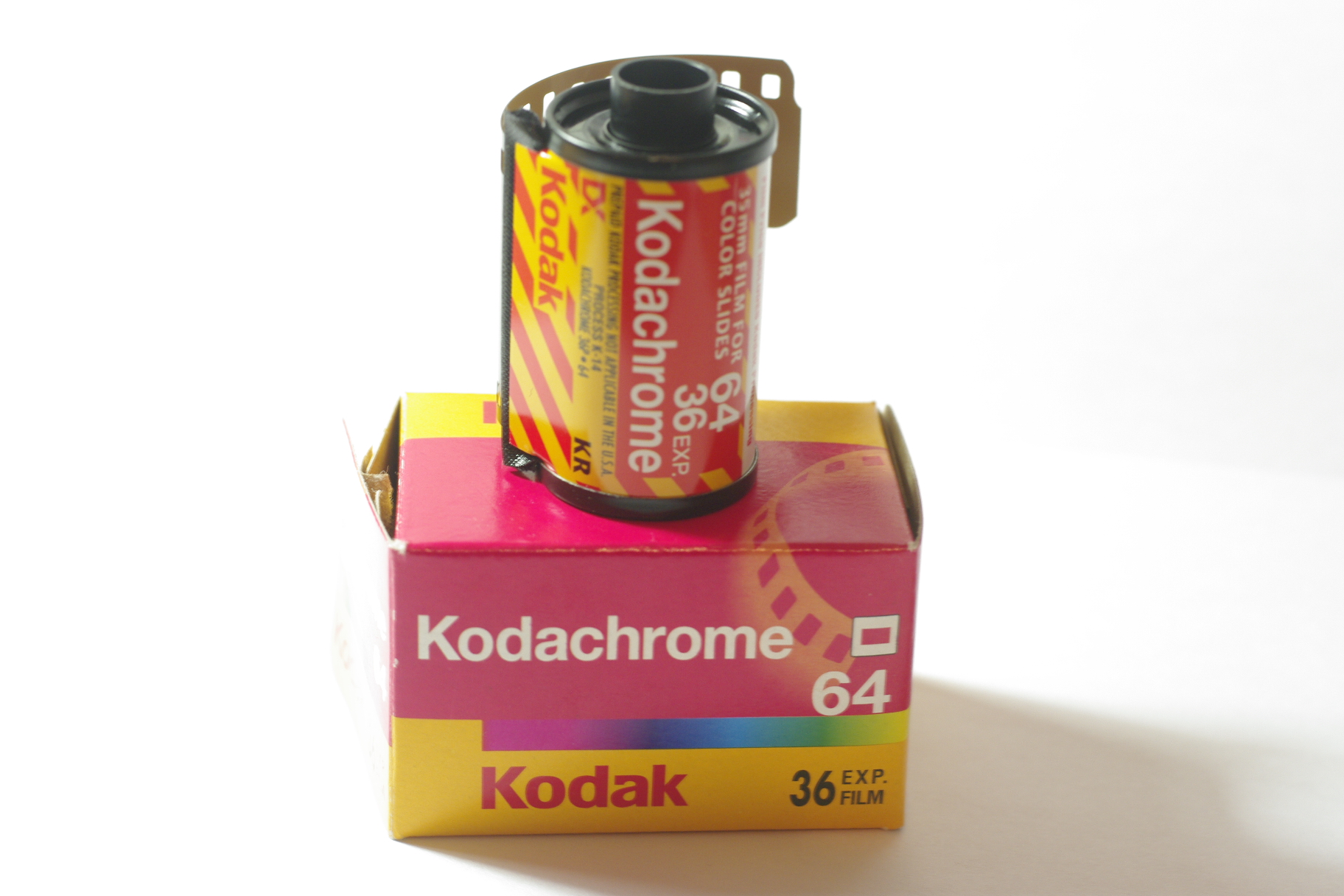
Overview
Kodachrome 64 was a 35mm color reversal (slide) film manufactured by Kodak from 1974 through June 2009. It is the most historically significant color photography film ever made — the direct descendant of the 1935 original Kodachrome, which itself was the first commercial mass-market color film. Famous for saturated-but-natural colors, exceptional sharpness, and 80+ year archival permanence, Kodachrome 64 was the workhorse of National Geographic, photojournalism, and fine-art slide photography for four decades before its discontinuation.[1]
A brief history
Kodachrome was introduced in 1935 by Kodak, invented by musicians Leopold Mannes and Leopold Godowsky Jr. The 1935 original was extraordinarily slow (ISO equivalent ~8), but the principle of three-layer subtractive color reproduction made it the technical template for every color film that followed.
The "Kodachrome 64" variant arrived in 1974 as the faster of two co-sold versions (Kodachrome 25 at ISO 25, and Kodachrome 64 at ISO 64). Subsequent refinements retained the K-64 name while improving sharpness and reducing grain. By the 1990s, Kodachrome 64 was the de facto professional slide standard for travel, documentary, and landscape work.
Manufacture ended in June 2009. The last roll ever sold was No. 6034 (Kodachrome's final production run): 36 exposures, custom-hand-numbered, and presented by Kodak's then-CEO Antonio Perez to photographer Steve McCurry, who shot it in New York and Parsons, Kansas.
The K-14 process — why it was different
Every other color film you've shot — C-41 negatives, E-6 slides — uses chromogenic chemistry: the film itself contains color dye couplers in each emulsion layer, and development releases the dyes. Kodachrome was categorically different.
Kodachrome film was fundamentally a three-layer panchromatic black-and-white film. The three layers were sensitized differently (one for red, one for green, one for blue), but they contained no color couplers. Color was introduced during the K-14 processing:
- Black-and-white first development exposes silver in each layer proportional to that color's scene intensity
- The film is re-exposed to red light, and a red-dye coupler in the developer forms cyan (complementary) dye in the red-sensitized layer
- Re-exposed to blue, with yellow-dye coupler forming blue-complementary in the blue-sensitized layer
- The remaining silver is developed with a magenta coupler
- Silver is bleached away, leaving only dyes
- Stabilize, rinse, dry
The 14 chemical steps required precise temperature control (some at 100°F ± 0.5°F) and specific re-exposure equipment. This complexity meant K-14 could only be run at scale by dedicated labs — at its peak, there were a few dozen K-14 labs worldwide; by 2010, only one.
Because the color couplers lived in the developer rather than the film, Kodachrome's dye stability in the final image was remarkable (see "Legacy and archival permanence" below), and the film's resolving power was measurably higher than E-6 stocks — there were no coupler particles sitting in the emulsion to scatter light.
Discontinuation timeline
- June 2009 — Kodak announces end of Kodachrome manufacture after 74 years
- 2009–2010 — existing stocks sell through; photographers buy out remaining supply
- December 30, 2010 — Dwayne's Photo (Parsons, Kansas), the last K-14 lab in the world, processes its final roll
- Post-2010 — no K-14 processing exists anywhere; unexposed Kodachrome can no longer be processed to color
Unexposed Kodachrome still surfaces in freezer finds, estate sales, and online auctions. It cannot be processed to color, but can be developed as panchromatic black-and-white in Pyro or Microdol-X with a bleach-bypass workflow — see "Can you still shoot Kodachrome?" below.
Narrow latitude — the slide-film reality
Kodachrome 64, like all reversal (slide) films, has approximately ±⅔ stop of exposure tolerance. This is categorically different from color negative latitude:
- Negative film (Portra 400/800, Gold, Ultramax) forgives overexposure. Rate a 400-speed film at EI 200 and the negative is richer, not ruined.
- Reversal film (Kodachrome, Ektachrome, Velvia) forgives nothing. One stop over and highlights are clipped to paper-white. One stop under and shadows are blocked to pure black.
Practical consequence: Kodachrome demands careful spot metering, bracketing of unfamiliar scenes, and explicit exposure-value discipline. Photographers trained on negative film (with its wide latitude) often over-expose Kodachrome until they learn the slide-film reflex.
Using an incident meter (pointed at the subject from the subject's position, reading the light falling on the scene) tends to produce more consistent Kodachrome exposures than reflected-metering through the lens. Gray-card metering is the fallback.
Color palette and "the Kodachrome look"
Kodachrome's color signature is the reason photographers still chase its aesthetic today:
- Saturation — high but controlled. Greens and reds particularly deep; blues less exaggerated than Velvia. Paul Simon's 1973 song "Kodachrome" ("they give us those nice bright colors, they give us the greens of summers") captures the cultural read.
- The famous "Kodachrome red" — a slightly magenta-shifted, deeply saturated red that rendered uniquely on this film. Impossible to replicate exactly on E-6 stocks because the process chemistry differs.
- Skin tones — warmly rendered but not excessively so; less warm than modern Portra, less neutral than Ektachrome
- Greens — blue-green bias; foliage reads vibrant but not quite as chartreuse as Velvia
- Blacks — deep and solid, without the color tinting that some E-6 stocks show in deep shadows
- Engineered for projection — Kodachrome was designed to look right on a slide projector at normal screen luminance. The palette feels exactly right in that context and sometimes reads as slightly-too-saturated on modern high-dynamic-range digital scans or displays.
Sharpness and grain
Kodachrome 64 had exceptional sharpness for its era:
- Grain — extremely fine. At typical scanning resolutions (2400–4000 DPI), grain is essentially invisible. On 8000 DPI drum scans the structure becomes visible but remains fine.
- Resolving power — measurably higher than any E-6 reversal film, for the reason noted above: no coupler particles embedded in the emulsion.
- Print sizes — Kodachrome 64 routinely held up to 16×20 enlargements from 35mm with sharpness comparable to 120-format E-6.
At typical projection sizes (slides shown on a 6-foot screen at 10 feet), sharpness was effectively unlimited.
Reciprocity failure
Kodachrome 64 had well-behaved reciprocity compared to its contemporaries. Compensation needed:
- ~1 second metered — no meaningful correction
- 10 seconds metered — ~½ stop additional; slight color shift begins
- 60 seconds metered — ~1–1.5 stops additional; visible color shift (cool/blue cast)
- Beyond 60 seconds — bracketed testing required; color casts become hard to correct
See [[reciprocity-failure]] for the underlying mechanism and Reciprocity Failure Compensation for the full per-stock workflow.[1]
Can you still shoot Kodachrome?
The universally-asked question. Answer: yes, but you cannot process it as color.
Options for unexposed Kodachrome stocks still available (freezer finds, eBay, auction estates):
- Process as black-and-white — Kodachrome can be developed in Pyro or Microdol-X as a panchromatic B&W film with bleach bypass. Results:
- Contrast runs high due to the film's steep characteristic curve
- Grain is visible but still fine
- Tonality is flattened; mid-tones are compressed
- This is the only reliable modern processing path
- Cross-process as E-6 — some adventurous labs offer E-6 processing of Kodachrome as a novelty. Results are unpredictable, usually disappointing. Not recommended for anything but experimentation.
- Leave it latent, scan specialized — unprocessed latent images can be scanned with dedicated equipment, but the process is expensive, niche, and produces monochrome at best.
- Don't process at all — some collectors keep unexposed Kodachrome as memorabilia, especially the final 2009 production rolls with their distinctive packaging.
The practical answer for most photographers: you cannot shoot new color Kodachrome images. If you want the Kodachrome look today, see the "Modern 'Kodachrome look' workflow" section below.
Legacy and archival permanence
Kodachrome's dye stability under proper storage is genuinely historic. Slides from the 1930s and 1940s, kept in dark storage at moderate humidity, still show their original colors with minimal fading. National Geographic's Kodachrome archive — thousands of professionally-stored 35mm slides from the 1940s through the 2010s — is among the most valuable color photography archives in existence.
Steve McCurry's "Afghan Girl" (Sharbat Gula, 1985 National Geographic cover) was shot on Kodachrome. The image's durability through 40 years of exhibition printing and digitization demonstrates the film's archival qualities. McCurry was gifted the last Kodachrome roll from Kodak's final production run in 2010; he shot it in New York and Kansas, and the images are archived at the Eastman Museum.
For archivists and collectors, Kodachrome's stability compares favorably to every chromogenic color process ever made. E-6 slides show perceptible dye shifts after 30–50 years; C-41 negatives fade similarly. Kodachrome's dyes, once formed in processing, remain remarkably stable for the life of the image.
Comparison with alternatives
Readers searching "kodachrome 64 vs X" want practical guidance:
| Film | ISO | Process | Current | Palette |
|---|---|---|---|---|
| Kodachrome 64 | 64 | K-14 (obsolete) | Discontinued 2009 | Saturated, warm reds, blue-green foliage |
| Ektachrome 100 | 100 | E-6 | Current (Kodak) | More neutral, cooler than Kodachrome |
| Velvia 50 | 50 | E-6 | Current (Fuji) | Higher saturation, greener foliage |
| Provia 100F | 100 | E-6 | Current (Fuji) | Most neutral of the reversal stocks |
| Cinestill 50D | 50 | C-41 | Current | Color negative, not reversal; daylight-balanced cinema film |
Closest modern analog — Fujichrome Provia 100F for neutral/balanced work; Fujichrome Velvia 50 for the-highest-saturation-possible work. Neither captures the exact Kodachrome palette, but both are processable at any E-6 lab.
The modern "Kodachrome look" workflow
For photographers who want Kodachrome's aesthetic today without a time machine:
- Shoot Ektachrome 100 or Provia 100F — processed as E-6 at any commercial lab
- Scan with a Kodachrome emulation ICC profile — several custom profiles exist that approximate Kodachrome's color signature: custom ICC profiles modeled on Kodachrome scans (some pro labs offer these), custom LUTs for Lightroom/Capture One
- Edit in RAW/TIFF to mimic Kodachrome's contrast curve (slightly S-shaped, with rich shadows and controlled highlights)
- Print on glossy paper — Kodachrome's look is optimized for projection/light-table viewing; glossy printing preserves more of the saturation
This workflow is the pragmatic 2026 approximation. It's not exact — the K-14 process's dye chemistry is genuinely irreproducible — but for web publishing and most print sizes, a Provia 100F + Kodachrome ICC combination is visually indistinguishable to non-experts.
Format
Kodachrome was produced almost exclusively in 35mm (135) cartridge format throughout its 74-year run. A brief 120 (medium format) run existed in the 1960s but was discontinued; 4×5 sheet film was never offered commercially.
For medium-format or large-format slide work today, Kodak Ektachrome (120 reintroduced 2018) or Fuji Provia/Velvia in 120 are the options.
Related films and techniques
- Reciprocity Failure Compensation — Kodachrome 64's reciprocity curve is part of this page's compensation discussion
- Kodak Kodachrome 200 — the discontinued ISO 200 sibling
- Kodak Portra 800 — Kodak's current low-light professional film (color negative, not reversal) for the opposite use case
References
- BOOK The Negative 1st ed. Little, Brown and Company, 1981. ISBN 0-8212-1131-5. ↩