Rollei Rolleiflex 2.8F
Introduced: 1960 Discontinued: 1981
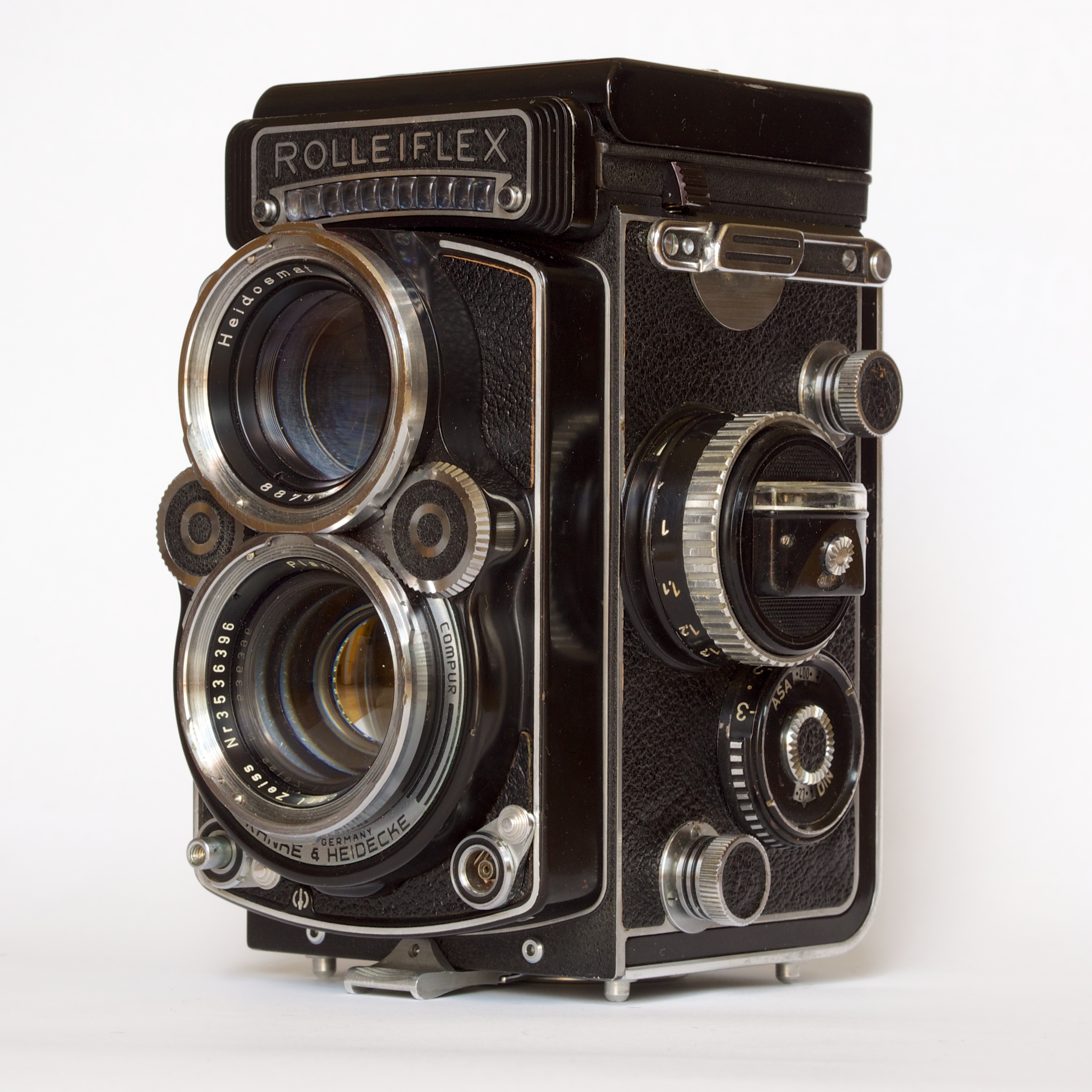
Rolleiflex 2.8F is the iconic Rollei TLR — in production 1960-1981. The "2.8" indicates the maximum aperture of the taking lens (Carl Zeiss Planar 80mm f/2.8); the "F" indicates the flagship F-series body. Among the most-revered medium-format cameras in photography history.
Key features
- 6×6 cm format on 120 (12 exp) or 220 (24 exp via interchangeable spool kit)
- Fixed Carl Zeiss Planar 80mm f/2.8 taking lens (later Schneider Xenotar 80mm f/2.8 on some F-series; both are 5-element double-Gauss class)
- Fixed Heidosmat 80mm f/2.8 viewing lens
- Synchro-Compur leaf shutter — 1s to 1/500, X-sync at all speeds
- Crank-wind film advance
- Built-in selenium-cell meter (early F) or LVS-coupled CdS meter (later F)
- Sportsfinder + waist-level finder — eye-level prism finder available accessory
Practical notes
- Rolleiflex 2.8F bodies on used market: $1500-3500 for working examples; near-mint can exceed $5000
- The most-coveted Rolleiflex F-series — among the most-collectible medium-format cameras
- Common service items: viewing-lens fungus (frequent issue on stored bodies), leaf-shutter calibration, light-trap foam
- The Planar f/2.8 is sharp at f/4 and exceptional by f/8; the f/2.8 wide-open performance is the "Rollei look" valued for portraiture
- The 2.8F is the standard for medium-format portrait work in the 20th century — used by Helmut Newton, Diane Arbus, Vivian Maier, and countless wedding/editorial photographers
Cultural significance
The Rolleiflex 2.8F is the medium-format TLR — the camera referenced when photography historians describe "the Rolleiflex." Diane Arbus's iconic late-career portraits were primarily shot on Rolleiflex 2.8F bodies; Helmut Newton used them for fashion. The TLR design influenced countless cameras and remains the reference for waist-level square-format photography.
Related cameras
- Rolleiflex 3.5F — slower-aperture 3.5F sibling (lighter and cheaper)
- Yashica Mat-124G — most-affordable TLR alternative
- Mamiya C330 — interchangeable-lens TLR alternative
- Hasselblad 503CW — interchangeable-back/lens 6×6 SLR alternative