Rollei Rolleiflex 3.5F
Introduced: 1958 Discontinued: 1976
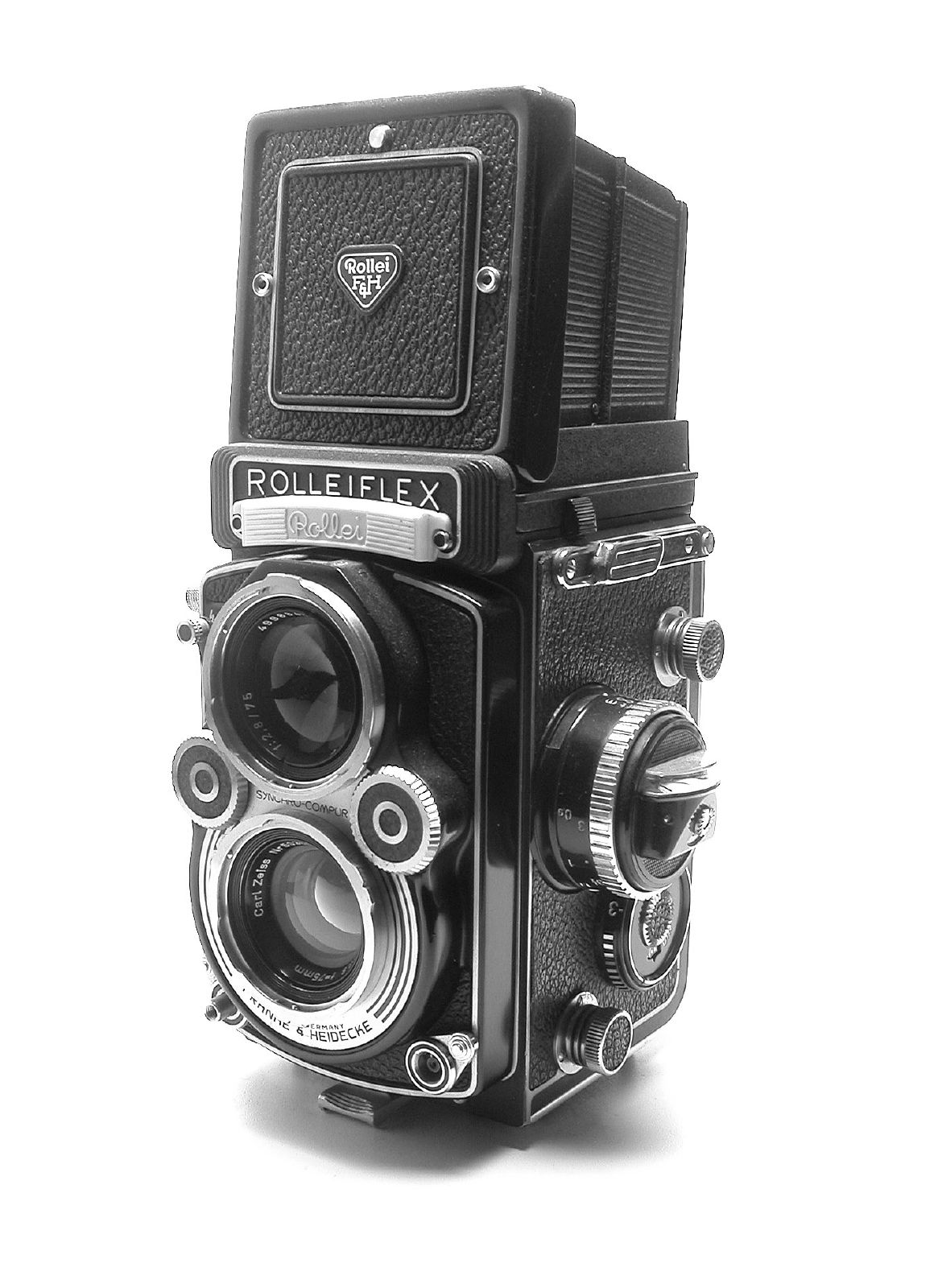
Rolleiflex 3.5F is the slower-aperture flagship Rolleiflex — in production 1958-1976. The "3.5" indicates the maximum aperture of the taking lens (Planar or Xenotar 75mm f/3.5); the "F" indicates the flagship body. Lighter and cheaper than the 2.8F, with comparable image quality at moderate apertures. Among the most-recommended medium-format TLRs for current buyers.
Key features
- 6×6 cm format on 120 (12 exp)
- Fixed Carl Zeiss Planar 75mm f/3.5 taking lens (most production); some Schneider Xenotar 75mm f/3.5 examples
- Fixed Heidosmat 75mm f/2.8 viewing lens (brighter than taking lens for focus brightness)
- Synchro-Compur leaf shutter — 1s to 1/500, X-sync at all speeds
- Crank-wind film advance
- Built-in selenium-cell meter (early F) or LVS-coupled CdS meter (later F)
- Lighter than 2.8F — substantially smaller and lighter
Practical notes
- Rolleiflex 3.5F bodies on used market: $800-1800 for working examples; lower than 2.8F
- The 75mm f/3.5 Planar is sharp wide-open and exceptional by f/8 — comparable image quality to 2.8F at f/5.6 and smaller
- Common service items: viewing-lens fungus, leaf-shutter calibration, light-trap foam
- Often recommended over 2.8F for current buyers — comparable image quality at lower price + lighter body
- The 75mm focal length differs slightly from the 80mm of the 2.8F — slightly wider angle of view
Cultural significance
The Rolleiflex 3.5F is the practical Rolleiflex — the camera many photography enthusiasts buy because the 2.8F is out of reach. Used widely in editorial and family photography in mid-20th century. The 3.5F preserves the Rolleiflex experience and image quality at substantially lower cost.
Related cameras
- Rolleiflex 2.8F — flagship f/2.8 sibling
- Yashica Mat-124G — most-affordable TLR alternative
- Mamiya C330 — interchangeable-lens TLR alternative