Kodak Plus-X 125
Characteristics
- Grain: fine
- Contrast: medium
- Latitude: moderate
- Formats available: 35mm, 120
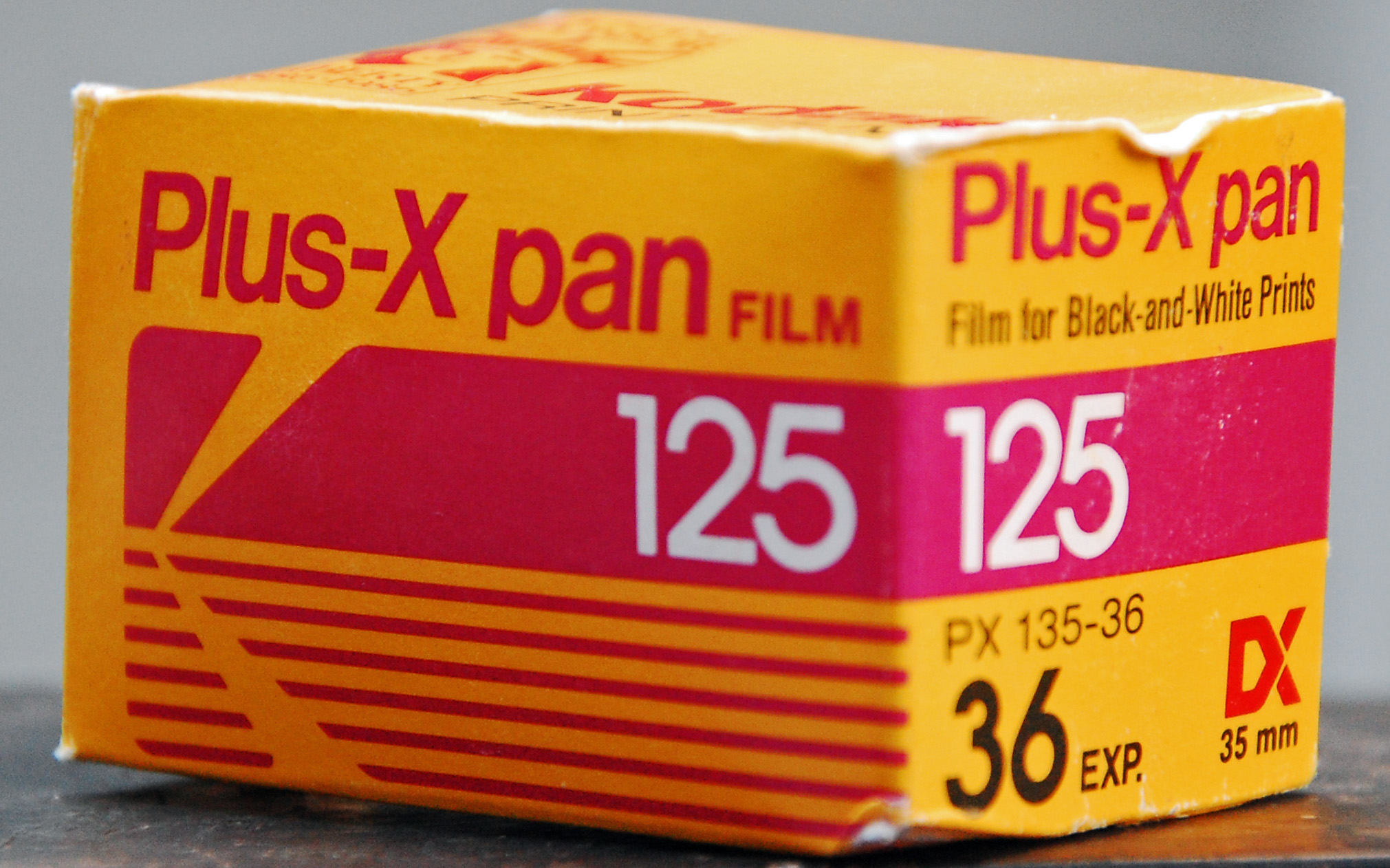
Overview
Kodak Plus-X 125 was the slower, finer-grained sibling of Tri-X 400 — Kodak's classic medium-speed cubic-grain panchromatic B&W film, in continuous production from 1938 to 2011. For seven decades it was the default Kodak choice for photographers who wanted Tri-X's tonal character with finer grain and tighter detail. School portrait studios, yearbook photographers, and pictorial wedding shooters stayed with Plus-X long after T-Max 100 was launched in 1986 — the warmer Kodak palette and forgiving cubic-grain response held loyalty that the modern T-grain successor never fully captured.[1]
The 35mm and 120 versions were discontinued by Kodak in 2011, ending a 73-year continuous-production run.
The Plus-X / Tri-X / Verichrome family
Plus-X belongs to Kodak's "X" series — pre-WW2 panchromatic films that defined Kodak's mid-century B&W identity:
- Verichrome Pan — the slow speed (ISO 125 final, originally ASA 50). Kodak's amateur snapshot stock; typically loaded in box cameras and Kodak Brownies. Discontinued 2002.
- Plus-X 125 (this film) — the moderate speed; the pictorial workhorse for serious amateurs and studios. Discontinued 2011.
- Tri-X 400 — the fast speed; documentary, photojournalism, available-light. Still in current production.
Kodak introduced Plus-X originally as a sheet film in 1938, then as Plus-X Pan in 35mm and 120 roll formats during the 1940s. The "Pan" designation distinguished panchromatic spectral response (sensitive to red as well as green and blue) from earlier orthochromatic stocks. The "Pan" suffix was eventually dropped from product packaging — in its final years the film was simply marketed as "Plus-X 125."
Speed history and the reformulations
Plus-X's box speed evolved through three eras:
- 1938–1960s — original ASA 50 (later ASA 64). Coarser grain than the final formulation; warmer rendering.
- 1960s–1990s — reformulated to ASA 80, then ASA/ISO 125 with the Plus-X Pan emulsion code update. This is the formulation most photographers know.
- Post-2000 to 2011 — minor refinements; nominal ISO 125 maintained. Final emulsion code was PXP (Plus-X Pan Professional) for the studio-grade variant.
The shift from ASA 50 to ISO 125 over three decades reflected Kodak's emulsion-chemistry improvements at the same nominal grain — by the 1990s formulation, Plus-X 125 had finer grain than the original 1938 ASA 50 stock.
Design philosophy — refined cubic grain
Plus-X used Kodak's traditional cubic-grain emulsion technology (the same family as Tri-X, Verichrome Pan, and the older sheet films), tuned for higher resolution at the cost of speed:
- Grain: visibly finer than Tri-X at the same enlargement; comparable to Verichrome Pan but with a more refined character. At 8×10 print sizes from 35mm, grain is barely perceptible; at 16×20+ enlargements, grain becomes a soft texture rather than the structured "Tri-X look."
- Tonality: classic Kodak warm — same shadow undertone as Tri-X, gentler highlight bloom
- Latitude: moderate (±1½ stops without visible quality loss). Less forgiving than Tri-X's ±2 stops but still generous compared to slide film or T-Max.
- Response curve: gentle S-shape, similar to Tri-X but with a slightly steeper midtone slope — this is what gave Plus-X its "creamier" rendering reputation among portrait photographers.
Exposure characteristics
Plus-X 125's box-speed rating was honest, but pictorial photographers commonly overexposed:
- EI 125 (box) — accurate; works for average-contrast scenes
- EI 100 — common pictorial rating; ⅓-stop overexposure produces richer midtones and shadow detail. The "true" Plus-X speed for portrait and landscape work, by the same logic that made EI 320 the unofficial Tri-X rating.
- EI 80 — more aggressive overexposure for fine-art B&W work; develop at box time for delicate highlights
Plus-X was rarely shot at speeds above box. Unlike Tri-X (the canonical push film), Plus-X was almost always used at or below its rated speed — its pictorial cult was built around exposure generosity, not push tolerance.
Development workflows
Plus-X was friendly to nearly every standard B&W developer:
- Kodak D-76 1:1 — the classic pairing; 6:30 at 68°F for EI 125. Reliable, reproducible, moderate grain. The most-recommended Plus-X workflow.
- Kodak HC-110 Dilution B — 4:30 at 68°F for EI 125. Convenient (one-shot concentrate, long shelf life); slightly more grain than D-76.
- Kodak Microdol-X 1:3 — 9:00 at 68°F for EI 125. Maximum fine-grain rendering; slight effective speed loss to ~EI 100. Preferred for big-enlargement landscape work.
- Ilford Microphen — 6:00 at 68°F for EI 125. Modest speed-increase character; pairs well for the rare push to EI 250.
- Agfa Rodinal 1:50 — 9:00 at 68°F for EI 125. Maximum acutance; grain pronounced — defeats Plus-X's fine-grain advantage but produces a distinctive "edge-rendered" look some photographers preferred.
Reciprocity failure
Plus-X follows classic cubic-grain reciprocity behavior. Approximate Schwarzschild exponent: p ≈ 1.3 (same as Tri-X).
| Metered exposure | Actual exposure | Correction |
|---|---|---|
| 1s | ~1.5s | +½ stop |
| 10s | ~30–50s | +1½ stops |
| 60s | 5–10 min | +3 stops |
See Reciprocity Failure Compensation for the full per-stock comparison table.[1]
Push processing — usable but not the canonical push film
Plus-X pushed cleanly to EI 250 (+1) and acceptably to EI 400 (+2), but it was not the film photographers reached for when they needed push speed — that was always Tri-X. Push behavior:
- EI 250 (+1 push) — clean; minor grain increase. Microphen at 7:30 or HC-110 Dil B at 6:00.
- EI 400 (+2 push) — usable; grain becomes Tri-X-like, shadow detail compressed. Microphen at 9:30 or HC-110 Dil B at 8:30.
- Beyond EI 400 — possible but increasingly impractical; T-Max 400 or Tri-X were better choices.
See Push Processing for general theory.
Tonal palette
Plus-X delivered the Kodak warm-leaning B&W rendering with a finer-grain, smoother-midtone character than Tri-X:
- Shadows — warm undertones (Kodak family signature); cleaner block-up than Tri-X
- Midtones — creamy and gradual; the steeper midtone slope made portrait skin look "rounded" rather than flat
- Highlights — bloom slightly less than Tri-X; cleaner separation in upper zones
- Grain — fine, even, restrained. Not a "feature" the way Tri-X grain was — Plus-X grain was meant to be invisible.
This rendering made Plus-X the pictorial portraitist's choice — finer grain meant skin texture rendered without the structural grain that gave Tri-X its documentary character.
Format availability (historical)
Through most of its production life, Plus-X was offered in:
- 35mm — 36-exposure cassettes (PX), pro packs of 5
- 120 — 5-roll pro packs (PXP / Plus-X Pan Professional)
- 4×5 sheet — Plus-X Pan Professional 4147; offered into the 1990s, dropped before the final 2011 35mm/120 discontinuation
- 8×10 sheet — historically; dropped earlier than 4×5
The Plus-X Pan Professional grade had a distinct studio identity — it was the film commercial portrait studios specified for school yearbook contracts and wedding pictorial work through the 1980s and 1990s. The "Professional" designation guaranteed tighter batch-to-batch consistency than retail Plus-X Pan.
The 2010–2011 discontinuation
Kodak announced the cessation of Plus-X Pan in June 2011, citing declining sales as part of the broader B&W market contraction. T-Max 100 was nominally positioned as the replacement, but the two films had different character — T-Max's T-grain emulsion produced a cooler, more modern rendering that pictorial photographers using Plus-X had explicitly rejected.
The discontinuation was not a surprise: Verichrome Pan had been discontinued in 2002, and Plus-X had survived an additional nine years partly because of the Plus-X Pan Professional studio market. When school-portrait labs began transitioning to digital workflows in the late 2000s, the Professional grade lost its institutional buyer base and Kodak consolidated remaining demand into T-Max 100.
Final stocks shipped through the second half of 2011. Freezer-stored Plus-X from the 2011 batches was still being shot in 2026 with reports of minor base-fog increase but otherwise full performance.
Don't confuse with the aerial / motion-picture variants
Three other "Plus-X" branded products existed under separate Kodak emulsion codes — these are not the same film and behave differently:
- Plus-X Aerographic Type 2402 / SO-180 — aerial reconnaissance film; extended red sensitivity; different base material; sold to government and survey customers. Occasionally surfaces on the used market — do not assume it behaves like pictorial Plus-X 125.
- Plus-X Negative 5231 (35mm cinema) / 7231 (16mm cinema) — motion-picture negative stock; ECN-2 process compatible; not C-41 or B&W still development. Discontinued from cinema use ~2010 alongside the still product.
- Plus-X Reversal 7276 (16mm) — reversal motion-picture stock; B&W reversal processing. Discontinued earlier than the negative variant.
When buying freezer-stock Plus-X for still photography, confirm the code is PX (35mm cassette) or PXP (120 / Professional). Aerographic and motion-picture stocks have unrelated workflow assumptions.
The modern analog — Ilford FP4 Plus 125
For photographers who want the Plus-X aesthetic today, Ilford FP4 Plus 125 is the closest current production substitute. FP4 Plus shares Plus-X's box speed (ISO 125), cubic-grain emulsion technology, similar tonal character (slightly cooler than Plus-X's warm Kodak bias but in the same family), and comparable latitude. Ilford's development times in D-76 1:1 (~6 minutes at 68°F for EI 125) are within seconds of Plus-X's, so legacy darkroom notes for Plus-X transfer to FP4 Plus with only minor adjustment.
The remaining differences are aesthetic rather than technical:
- FP4 Plus has a marginally cooler shadow rendering vs Plus-X's warm Kodak bias
- FP4 Plus's midtone slope is slightly gentler — closer to HP5 Plus's character than to Plus-X's "creamier" portrait response
- FP4 Plus is available in 4×5 and 8×10 sheets in current production — so for large-format pictorial work, FP4 Plus is the obvious live choice
If preserving the Plus-X look is essential (commercial reproduction work, exact-match restorations of older portrait series), freezer-stock Plus-X is still findable on the used market through 2026, with the caveat that base fog will be marginally higher than fresh stock.
Comparison with sibling and competitor stocks
| Film | Speed | Grain | Tonal character | Status |
|---|---|---|---|---|
| Plus-X 125 (this film) | ISO 125 | Fine cubic | Warm Kodak; creamy midtones | Discontinued 2011 |
| Kodak Tri-X 400 | ISO 400 | Coarse cubic | Warm Kodak; structured grain | Current production |
| Kodak T-Max 100 | ISO 100 | Fine T-grain | Cooler, modern | Current production |
| Ilford FP4 Plus 125 | ISO 125 | Fine cubic | Cooler than Plus-X; similar grain | Current production — closest analog |
| Ilford Delta 100 | ISO 100 | Fine T-grain | Neutral Ilford palette | Current production |
| Fuji Neopan Acros II 100 | ISO 100 | Fine SFG | Crisp neutral; near-linear reciprocity | Current production |
Plus-X's distinctive position: Kodak warm + cubic-grain pictorial response at moderate speed. The combination doesn't survive in current production — T-Max 100 is finer-grained but cooler; Tri-X is the same palette but coarser; FP4 Plus is the same speed and grain technology but cooler. Photographers wanting the exact Plus-X rendering must source freezer stock or accept that FP4 Plus 125 is "close, not identical."
Famous use cases
- School portrait studios — Plus-X Pan Professional was the institutional standard for school yearbook contracts through the 1980s and 1990s
- Wedding pictorial work — finer grain than Tri-X for engagement portraits, ceremony candids in well-lit churches
- Fine-art landscape (4×5 sheet) — Plus-X Pan Professional 4147 was a Zone System favorite when Kodak Royal Pan (the slower 50-speed pictorial sheet) was unavailable
- Studio commercial — controlled-lighting product photography where T-grain's cooler rendering was rejected
- Yearbook and editorial portraiture — the Kodak warm palette flattered skin without the documentary grain of Tri-X
Plus-X never had Tri-X's photojournalism celebrity-photographer associations (no Frank, Winogrand, or Moriyama signature stock), but its commercial-pictorial footprint was vast — millions of school portraits, wedding albums, and yearbook pages from the 1950s through 2000s were shot on Plus-X.
Workflow recommendations per use case
- Portrait — EI 100 (overexpose ⅓ stop) in D-76 1:1 at 6:30; the classic Plus-X portrait recipe
- Landscape (35mm/120) — EI 100 in Microdol-X 1:3 at 9:00; finest-grain rendering
- Landscape (4×5 sheet stock if available) — EI 125 in HC-110 Dil B at 4:30; classic Zone System workflow
- Studio with controlled lighting — EI 125 box-speed in D-76 1:1 at 6:30
- Available-light pictorial — EI 250 (+1 push) in Microphen at 7:30; not Plus-X's strength but workable
Related films and techniques
- Kodak Tri-X 400 — the faster sibling; same cubic-grain family, coarser grain, push-tolerant
- Kodak T-Max 100 — Kodak's positioning replacement; T-grain modern character
- Ilford FP4 Plus 125 — the closest current-production analog
- Ilford Delta 100 — alternative T-grain at similar speed
- Fuji Neopan Acros II 100 — the reciprocity-champion alternative
- Push Processing — Plus-X's modest push capability
- Reciprocity Failure Compensation — Plus-X's standard cubic-grain behavior in context
- Zone System Exposure — Plus-X Pan Professional 4×5 was a Zone System workflow staple
References
- BOOK The Negative 1st ed. Little, Brown and Company, 1981. ISBN 0-8212-1131-5. ↩